✖

Updated:
October 1, 2026
Written By:
Liz Robson
Most school leaders can name the three tiers of mental health and wellbeing support without hesitation. Universal provision for all pupils. Specialist or CAMHS referral for those with the most significant needs. And in the middle, targeted support for pupils who need more than a whole-class approach but haven't yet reached the threshold for clinical intervention.
That middle tier is where the pressure lands hardest right now. Attendance remains a persistent challenge. Ofsted's September 2026 inspection toolkit asks whether pastoral support is well matched to pupils' needs and addresses underlying issues to prevent problems recurring. The DfE's Inclusion Bases in Schools guidance (June 2026) is unambiguous: belonging is not a by-product of good inclusion practice — it is its stated purpose.
The Anna Freud/DfE targeted support guidance from the same year sets out clear criteria for what counts as an appropriate early-intervention offer in that middle tier. Yet in practice, the options available to schools remain limited, leaving many to navigate this space without a clear or well-supported pathway forward.
So here are some questions worth sitting with:
One option that often goes unconsidered is student wellbeing coaching. Not because it lacks evidence or credibility, but because of a genuine structural blind spot in how the sector currently signposts this kind of support. That blind spot is worth understanding. Once you can see it, the decision about whether coaching belongs in your targeted support offer becomes a straightforward professional judgement, not a leap of faith.
And that judgement starts with belonging itself — because the evidence is becoming impossible to ignore.
If you work directly with young people and you want to develop the skills to offer this kind of support with confidence, the Worth-it Coach Training programme is built for exactly that. It is accredited by the Association for Coaching, grounded in positive psychology and Self-Determination Theory, and designed for teachers, youth workers, and support staff who want to use coaching responsibly and effectively with the young people in their care.
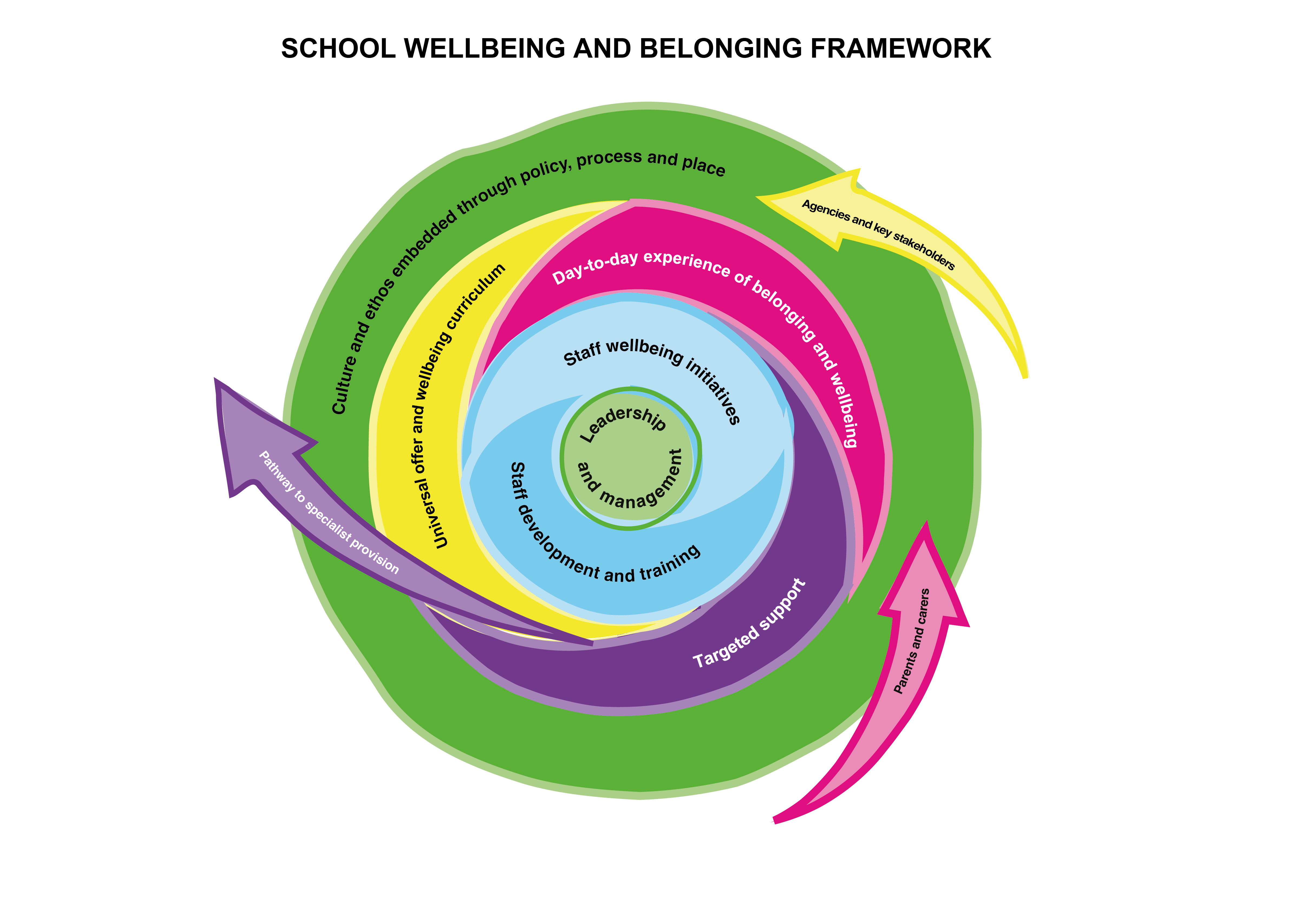
The case for paying close attention to belonging is no longer a pastoral instinct. It is a measurable attainment issue.
A 2026 University of Cambridge study, linking PISA 2022 survey data to National Pupil Database records for 4,763 pupils across 165 English schools, found that pupils who strongly disagree they belong at school score on average 7.72 points lower on attainment than those who strongly agree — after controlling for prior attainment, demographics, and bullying.
That is roughly a full GCSE grade across eight subjects. The relationship held on both of the study's belonging measures and remained significant regardless of whether bullying was included in the modelling.
The study also found that belonging is unevenly distributed. Pupils eligible for free school meals, pupils with special educational needs, and girls all report lower average belonging than their peers on at least one measure. In other words, the pupils most likely to be on your targeted support radar are also, on this evidence, the pupils least likely to feel they belong.
Pupils eligible for free school meals, pupils with special educational needs, and girls all report lower average belonging than their peers.
This is not an isolated finding. A meta-analysis by Allen et al. (2018), pooling 51 studies and 67,378 students, found that low belonging predicts absenteeism, disengagement, and dropout. Its headline finding is worth reading carefully:
"Teacher support and positive personal characteristics were the strongest predictors of school belonging." — Allen et al., 2018
The strongest lever schools have over belonging is not a curriculum redesign or a change to the physical environment. It is the quality of a supportive adult relationship, followed closely by building a young person's own positive personal characteristics: coping skills, self-efficacy, hope, and resilience. Both levers sit squarely within what a structured coaching relationship is designed to do.
The Cambridge report does not just demonstrate a correlation between belonging and attainment. It sets out an explicit theoretical explanation for why belonging matters, drawing on Self-Determination Theory (Deci and Ryan, 1985).
Self-Determination Theory proposes that human motivation is driven by three innate psychological needs: autonomy, competence, and relatedness. Belonging connects directly to relatedness. When students experience supportive relationships with their teachers, they become more intrinsically motivated, more consistently engaged, and more committed to their own learning.
This matters for how you think about student wellbeing coaching, because coaching as a discipline is built around exactly those three needs.
I want to be transparent about something here. When I read the Cambridge report, I was struck by the alignment between what Self-Determination Theory describes and what coaching is designed to do. The researchers use SDT to explain belonging in general. They are not making a case for coaching specifically. That connection is one I am drawing, informed by my own published research in this area. But when you look at the psychological needs SDT identifies as central to belonging, autonomy, competence, and relatedness, coaching addresses every single one of them. That is not a coincidence. It means student wellbeing coaching is not just a nice add-on alongside your belonging strategy. On the very theoretical model the DfE's own commissioned research uses to explain why belonging affects outcomes, coaching is working on the same underlying psychological needs.
Allen et al. (2018) adds an important detail. The meta-analysis defines teacher support, its strongest predictor of belonging, in terms that describe an autonomy-supportive relationship: teachers who promote mutual respect, care, encouragement, fairness, and autonomy, who expect students to do their best and scaffold learning to help them get there. Two independent evidence bases now describe the same pattern. Belonging is built through relationships that support a young person's agency and goals, not simply through warmth or proximity. That is a closer description of a coaching relationship than of most other adult-pupil interactions in a school day.
Student wellbeing coaching does not require a special exception to sit within the current DfE framework. It already meets the criteria the Anna Freud/DfE targeted support guidance (2026) sets out.
The guidance defines targeted support as mental wellbeing support aimed at specific individuals or groups, providing early or preventative support and forming part of a graduated response. It describes delivery by suitably trained staff, requires that content is relevant and accessible, and asks that evaluation is planned from the outset. It is explicit that education staff must not diagnose or deliver specialist mental health treatment. A non-clinical, strengths-based coaching model is designed to respect that boundary, not test it.
Coaching satisfies each of those criteria. It is early and preventative by design. It is delivered by trained practitioners. It is non-clinical and strengths-based. And structured coaching programmes include pre and post-outcome measures as standard.
The DfE's Inclusion Bases in Schools guidance (June 2026) goes one step further, naming coaching explicitly as a legitimate mechanism for deploying specialist expertise across a school and building inclusion capacity. It is clear that this refers to staff-to-staff coaching rather than pupil-facing delivery, but that framing is itself part of the story. The guidance already trusts coaching as a mechanism and prioritises belonging as a purpose. The gap it has not yet closed is applying a mechanism it trusts to the population it prioritises.
Ofsted's September 2026 inspection toolkit reinforces the same logic from a different direction. The strong standard descriptors across inclusion, attendance, and personal development reward leaders who understand pupils' barriers in detail and respond with evidence rather than assumption. A coaching offer, delivered by trained staff and evaluated from the outset, generates exactly the kind of pupil-level evidence those descriptors ask leaders to hold.
There's a second framework worth putting alongside the Anna Freud/DfE targeted support guidance, because it sharpens exactly where the gap in this article's title actually sits.
The government's SEND reform white paper, Every Child Achieving and Thriving, restructures support beyond the Universal Offer into two further layers, not one. Targeted support is delivered within a pupil's own mainstream setting: structured, evidence-based interventions for commonly occurring needs, requiring no external referral to begin. Targeted Plus sits above it, still short of Specialist provision, but drawing in additional input from education and health professionals, often through the reform's proposed Experts at Hand service, for pupils whose needs are more complex. Every child receiving Targeted or Targeted Plus support will have an Individual Support Plan, developed with parents, describing their day-to-day provision.
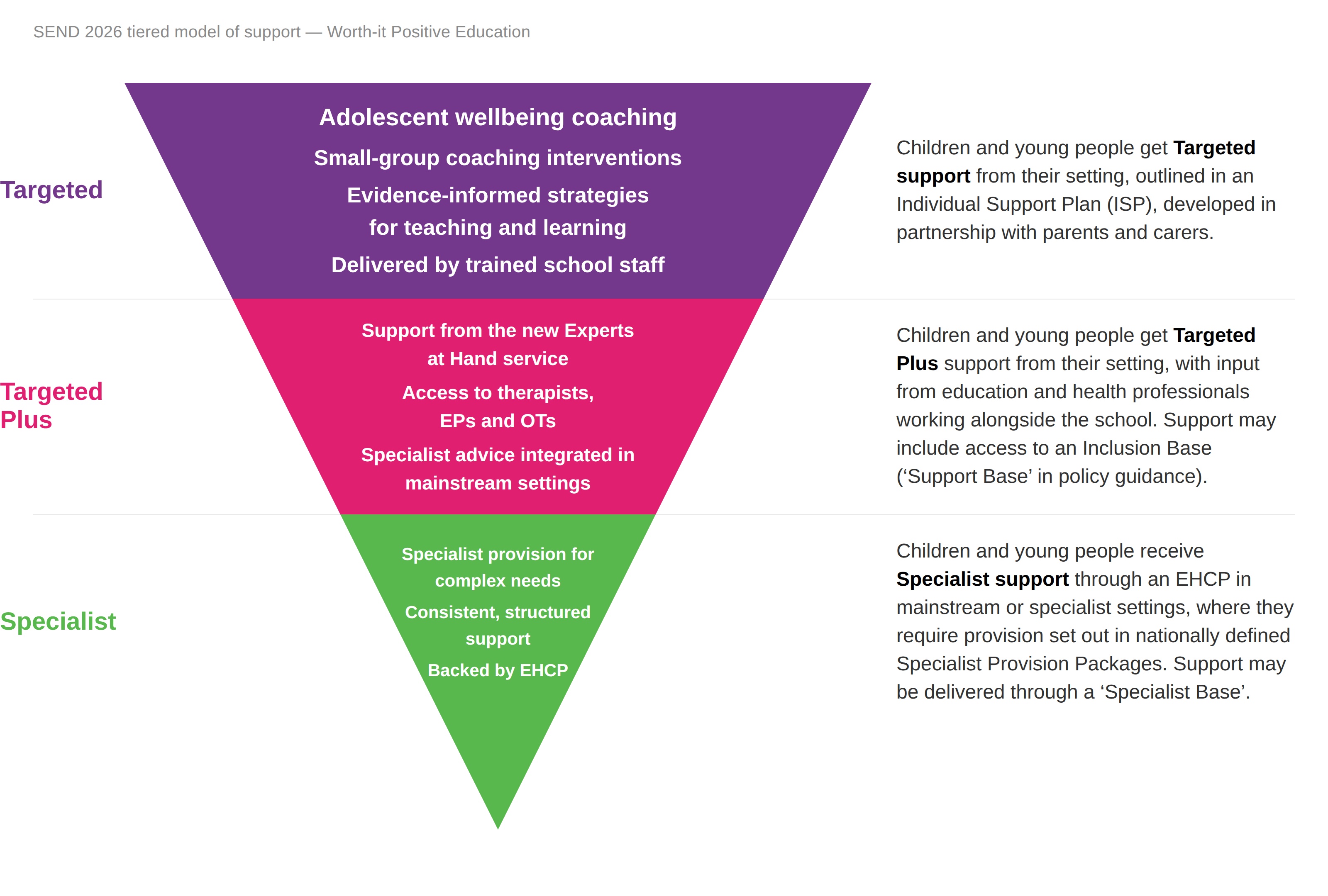
Here is the blind spot this distinction exposes. When a school identifies a pupil who needs "more than universal, but not clinical," the instinct is very often to reach upward, toward Targeted Plus, toward bringing in an external professional, commissioning a specialist service, or starting the conversation about a referral. That instinct isn't wrong. But it skips a layer. It treats the Targeted layer, the one a school can resource and deliver entirely from within its own staff, as though it barely exists as a distinct option.
That is precisely the layer student wellbeing coaching was built for. It requires no external referral. It is delivered by trained staff, within the school, as this article has already established against the Anna Freud/DfE criteria. It doesn't draw on health professional input the way Targeted Plus does, which means it isn't competing with, or duplicating, the more intensive, multi-agency layer above it. It sits exactly where the SEND reform's own structure says a school's in-house capacity should sit: evidence-based, non-clinical, delivered without waiting for a referral to clear.
To be equally clear about what coaching is not: it is not a substitute for Targeted Plus or Specialist provision where a pupil genuinely needs multi-agency or clinical input, and coaches are trained to recognise when a referral upward is the right next step rather than continuing to coach. The point isn't that coaching replaces the layers above it. It's that schools currently have very little named, credible provision at the Targeted layer itself, which means the choice too often collapses into "universal PSHE, or escalate," with nothing built to occupy the space in between. Coaching, delivered by staff you already employ, trained to a recognised standard, is what fills that specific space.
This also reframes the "where could you start?" question from earlier in this article. Before reaching for an external Targeted Plus commissioning conversation, or bringing in additional professionals through a service like Experts at Hand, it's worth asking whether your school has first built genuine capacity at the Targeted layer, the layer coaching occupies, and the layer that requires no referral, no waiting list, and no additional health-professional capacity that, across the system, is already stretched thin.
Not sure where targeted support and Targeted Plus fit against everything else on your school's current development priorities? Use the Wellbeing and Inclusion Planning Tool to map out where your existing provision sits, and where coaching could close the gap.
If you work directly with young people and you want to develop the skills to offer this kind of support with confidence, the Worth-it Coach Training programme is built for exactly that. It is accredited by the Association for Coaching, grounded in positive psychology and Self-Determination Theory, and designed for teachers, youth workers, and support staff who want to use coaching responsibly and effectively with the young people in their care.
Find out more about the Worth-it Coach Training programme.
Take the first step toward making a difference. Sign up for our free Introduction to Coaching Young People CPD bundle today and discover how coaching can enhance the wellbeing and resilience of the young people you support. Get started now!
Not sure if targeted support is the best starting point for your school? Use the Wellbeing and Inclusion Planning Tool to identify where coaching can make the biggest impact. Gain clarity, prioritize your next steps, and ensure your approach is tailored to your school’s needs. Complete the tool now and start building a stronger foundation for your students’ resilience and wellbeing.
Allen, K., Kern, M. L., Vella-Brodrick, D., Hattie, J., & Waters, L. (2018). What schools need to know about fostering school belonging: A meta-analysis. Educational Psychology Review, 30(1), 1–34. https://doi.org/10.1007/s10648-016-9389-8
Banerjee, P. (2026). School belonging and attainment at key stage 4: linked data study. University of Cambridge / Department for Education.
Campbell, M. A., & Gardner, S. (2005). A pilot study to assess the effects of life coaching with Year 12 students. In M. Cavanagh, A. M. Grant, & T. Kemp (Eds.), Evidence based coaching: Volume 1. Theory, research and practice (pp. 159–169). Australian Academic Press.
Deci, E. L., & Ryan, R. M. (1985). Intrinsic motivation and self-determination in human behaviour. Plenum Press.
Department for Education & Anna Freud. (2026). Developing your school or college targeted mental wellbeing support.
Department for Education. (2026, June). Inclusion bases in schools guidance.
Fazel, P., Eszter Kovács, K., & Kovács, J. (2025). Coaching in higher education: a systematic review of coaching intervention on university students. Coaching: An International Journal of Theory, Research and Practice, 19, 173 - 202.
Goodenow, C., & Grady, K. E. (1993). The relationship of school belonging and friends' values to academic motivation among urban adolescent students. Journal of Experimental Education, 62(1), 60–71.
Green, L. S., Grant, A. M., & Rynsaardt, J. (2007). Evidence-based life coaching for senior high school students: Building hardiness and hope. International Coaching Psychology Review, 2(1), 24–32.
Green, L. S., Norrish, J. M., Vella-Brodrick, D. A., & Grant, A. M. (2013). Enhancing well-being and goal striving in senior high school students: Comparing evidence-based coaching and positive psychology interventions. Institute of Coaching.
Passmore, J., & Brown, A. (2009). Coaching non-adult students for enhanced examination performance: A longitudinal study. Coaching: An International Journal of Theory, Practice and Research, 2(1), 54–64.
Robson-Kelly, L., & van Nieuwerburgh, C. (2016). What does coaching have to offer to young people at risk of developing mental health problems? A grounded theory study. International Coaching Psychology Review.
van Nieuwerburgh, C., & Barr, M. (2016). Coaching in education. In T. Bachkirova, G. Spence, & D. Drake (Eds.), The SAGE Handbook of Coaching. Sage.
van Nieuwerburgh, C., Zacharia, C., Luckham, E., Prebble, G., & Browne, L. (2012). Coaching students in a secondary school: A case study. In C. van Nieuwerburgh (Ed.), Coaching in education: Getting better results for students, educators and parents. Karnac.
van Nieuwerburgh, C., & Tong, C. (2013). Exploring the benefits of being a student coach in educational settings: A mixed-method study. Coaching: An International Journal of Theory, Practice and Research, 6(1), 5–24.



LAST UPDATED:
October 21, 2026
Close the pastoral support training gap for your school staff with accredited coaching training for educators.

LAST UPDATED:
October 14, 2026
Discover how coaching builds SENCO capacity for early intervention and staff development, and how accredited coach training can help.


.svg)


