✖

Updated:
September 23, 2026
Written By:
Liz Robson
More pupils than ever are struggling. Anxiety, low self-esteem, exam stress, disengagement. And behind each of those labels is a young person who needs something more than whole-school provision can offer. I know this because I've spent years not just researching this space, but working directly alongside schools, in classrooms, with pastoral teams, and alongside SENCOs, helping hundreds of schools and settings put the right targeted support in place for disadvantaged young people. The question I hear most often? What actually works?
The answer, backed by my own research and a growing body of evidence, is adolescent wellbeing lcoaching.
In this post, I want to walk you through what targeted support really means in practice, how student coaching (specifically positive psychology coaching) works as an intervention, and why I believe it deserves a central place in your school's support strategy, especially as the new Ofsted EIF comes into force from September 2026.
Schools are being asked to support a wider range of pupil needs than ever before. Rising rates of anxiety, depression, and disengagement mean that universal, whole-school provision alone often isn't enough. Some pupils need something more focused.
The evidence backs this up. A systematic review of reviews by McGovern et al. (2024) found strong support for both selective interventions, delivered to sub-groups at increased risk, and indicated interventions, which target young people already showing pre-clinical symptoms. Targeted support meets pupils where they are, rather than hoping a broad approach will reach everyone.
For school leaders, this matters on two fronts. First, it's the right thing to do for pupils facing barriers to their learning and wellbeing. Second, it's exactly what inspectors will be looking for under the renewed inspection framework. Getting targeted support right is both a moral and a strategic priority.
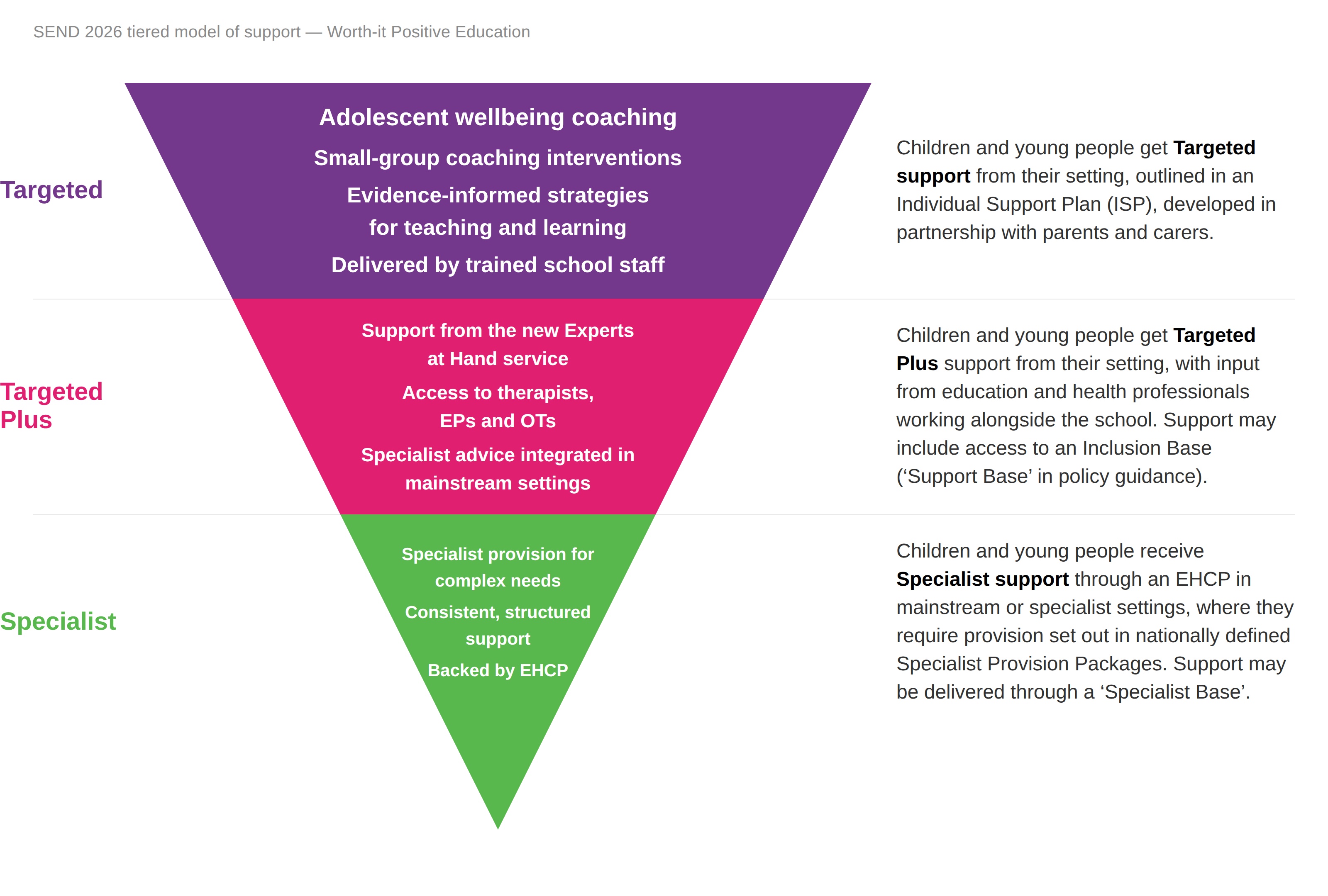
Targeted support refers to early or preventative mental wellbeing support aimed at specific individuals or groups of students who need more than universal, whole-school provision. It sits within the graduated approach, the continuous cycle of assess, plan, do, and review, that helps ensure pupils receive the right level of help.
Targeted support itself isn't a single, flat category. Under the SEND reforms, it spans two layers: Targeted, structured, evidence-based interventions delivered within a school's own mainstream setting, and Targeted Plus, a more intensive layer that draws in additional input from education and health professionals for pupils whose needs are more complex, but who still fall short of the threshold for Specialist provision.
Within that, targted interventions themselves tend to fall into two main types:
And the cost-effectiveness evidence is clear. Le et al. (2021) found that targeted prevention was likely to be more cost-effective than universal prevention, and that screening plus psychological intervention at school was one of the most cost-effective ways to prevent mental disorders in children and young people.
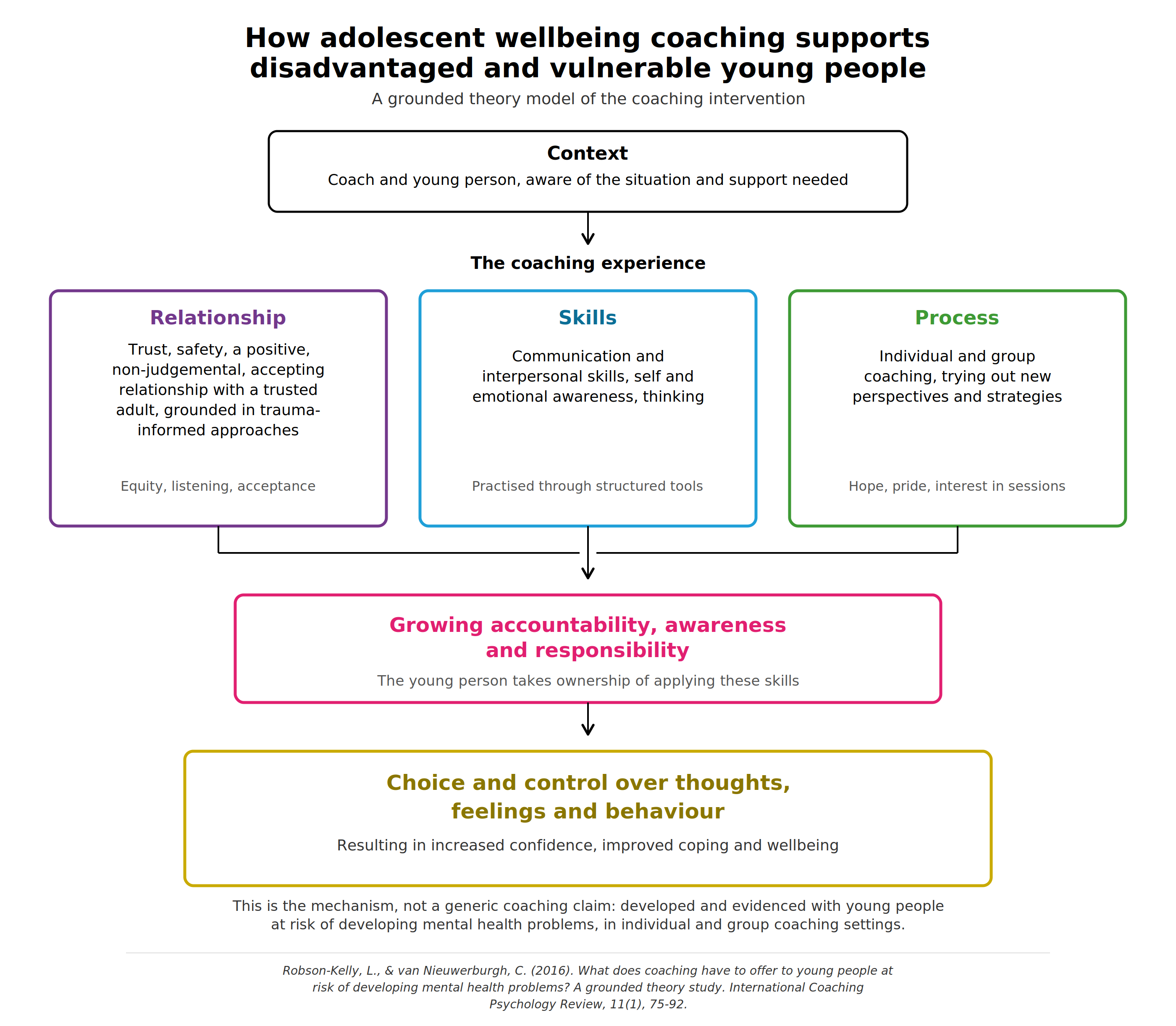
This is where I want to share something I feel genuinely passionate about. My research with van Nieuwerburgh (2016) explored how positive psychology coaching improves wellbeing for disadvantaged young people facing barriers to learning, and what we found was both clear and compelling.
Coaching is structured, forward-looking, and led by the young person's own desired outcomes. Rather than focusing on diagnosis or treatment, it helps pupils identify their strengths, set goals, and take practical steps to overcome what's holding them back. It works through regular one-to-one or small-group sessions built around a trusting relationship. And what makes it effective isn't just the structure. It's the quality of that relationship.
My research identifies three interrelated mechanisms through which coaching creates real change:
Three things run through my research and through effective coaching practice more broadly:
These ingredients explain something the wider evidence base often leaves unaddressed. Most studies report outcomes, such as reduced anxiety and improved coping, without explaining how an intervention worked. Coaching offers a clear account: a relationship built on trust and non-judgement gives young people the security to set goals and act on them.
Because coaching is led by the young person, it can flex to meet very different needs. In my research and practice, I've seen it make a real difference for students experiencing:
I want to be clear about this: coaching isn't a replacement for other forms of targeted support. It's a powerful addition to them. Think of it as another tool in your toolkit, one that sits alongside counselling, CBT, and mindfulness rather than competing with them.
Here's how they compare:
Coaching is firmly forward-looking. You're not directing the young person. You're guiding them to reach their own conclusions and take meaningful action.
And I'll be direct about something else: coaching is not a substitute for clinical therapy. If a young person's needs go beyond your remit, your role is to escalate and refer. Coaching works best at the pre-clinical stage, when a pupil is struggling but hasn't yet reached a clinical threshold. That's precisely where early, targeted support can make the biggest difference.
Coaching supports several evaluation areas in the Ofsted EIF and Schools Inspection Toolkit for use from September 2026, and for school leaders building a case for coaching, this alignment matters.
The toolkit asks inspectors to consider how leaders reduce barriers to students' learning and wellbeing through a graduated approach. Coaching is a practical way to deliver this cycle of assess, plan, do, and review. It's especially relevant for disadvantaged pupils, where a well-evidenced pupil premium strategy is expected. And because coaching is grounded in the young person's own goals, it naturally supports the pupil voice the toolkit values.
Inspectors look for timely, well-chosen, targeted interventions to support those who need additional help. Coaching fits this precisely, helping pupils develop the motivation, self-discipline, and resilience that the toolkit highlights as predictors of attainment.
The toolkit expects schools to develop pupils' confidence, resilience, and knowledge so they can keep themselves mentally healthy. My positive psychology coaching framework directly develops confidence, self-awareness, coping skills, and resilience. These are outcomes you can see in young people's lives, and the evidence inspectors will be looking for.
My research identifies three skill domains that effective coaching with disadvantaged young people should develop:
This framework and coaching toolkit gives teachers or pastoral practitioners a clear, practical map for sessions. It ensures that coaching with disadvantaged students isn't simply a supportive conversation. It's a progressive, skill-building process with real outcomes. Young people who engaged with this approach reported increased motivation, a more positive outlook on the future, greater confidence, and improved ability to manage their thoughts, feelings, and behaviour.
You don't need to overhaul everything. Targeted student coaching can be introduced thoughtfully, building on what your school already does well.
Start with early identification. Use a local needs assessment to spot students facing barriers to learning and wellbeing. Look for early indicators — declining attendance, low engagement, emerging anxiety — before challenges escalate.
Invest in your people. The most sustainable model is one where your own staff develop coaching skills. Building internal capacity means your support offer is shaped by your context, your students, and your community.
Measure what matters. Track outcomes like attendance, engagement, and wellbeing. Clear, well-analysed data tells a powerful story — for your team, your governors, and your inspectors.
Too many pupils are simply getting by. Coaching offers a real pathway to help them thrive — building the resilience, confidence, and self-belief they need to overcome barriers and reach their potential. It's targeted, cost-effective, relationship-driven, and it works.
If you're ready to take the first step, my Introduction to Coaching Young People CPD bundle is a practical place to begin. It's designed to help you and your team bring evidence-based coaching into your setting — and feel confident doing it.
And if you want something you can use straight away, download your free How to Explain Resilience to a Young Person workbook — a coaching-based resource to help you open up meaningful conversations with your students.
If you would like to understand how targeted support can fit in with your wider school inclusion stratagy use of Wellbeing and Inclusion Planning Tool.


.jpg)

LAST UPDATED:
October 12, 2026
This article explored just three ways positive psychology coaching can help young people develop mental wellbeing

LAST UPDATED:
September 30, 2026
Confused by "targeted support" or "Targeted Plus"? A clear, practical explainer for school staff on what these mean, and where to start.


.svg)


