✖

Updated:
October 14, 2026
Written By:
Liz Robson
SEND reform is asking SENCOs to stop being the person who holds every case and start being the person who builds everyone else's confidence. That is the right ambition. But a strategic role needs strategic capacity, and most SENCOs do not have it... yet!.
A note on names: the SENCO, or special educational needs coordinator, is the qualified teacher every mainstream school in England must appoint to coordinate support for pupils with special educational needs. Many schools say SENDCo (special educational needs and disabilities coordinator), and others use titles such as inclusion lead, inclusion manager or head of inclusion. In this article, "SENCO" covers all of them.
The National SENCO Workload Surveys have shown the same picture for years: too little protected time, too much administration, and too little room for the leadership work that changes practice. The 2026 reforms do not remove that pressure. They move it. If every member of staff must now be trained in SEND and inclusion, someone has to lead that learning, sustain it and check it is making a difference to pupils.
This article argues that coaching is one of the most practical ways to build that capacity. Not as a nice-to-have wellbeing add-on, but as a deliberate leadership tool that lets a SENCO reach pupils earlier and multiply their expertise across the staff team.
The direction of travel is clear: every adult in a school is responsible for inclusion, and the SENCO leads them. Four changes set that expectation.
Alongside these, the DfE's Inclusion bases in schools guidance (June 2026) expects evidence-informed, regularly reviewed interventions, and asks settings to give staff access to supervision, mentoring and coaching. Ofsted's renewed inspection toolkit, used from September 2026, looks for timely, well-chosen targeted support and asks whether pupils feel they belong.
Much of the White Paper is still being consulted on, and the detail will change. But the shape of the SENCO role it describes is unlikely to: less caseworker, more leader of learning.
The whole-staff training has already started to arrive. On 24 September 2026 the DfE published the first part of its free SEND and inclusion training materials, developed by Ambition Institute. They cover inclusive teaching, child development, and speech, language and communication, with more modules due during 2026/27. Schools are expected to deliver them in-house, selecting and adapting the content for their own staff and pupils.
Early reactions, reported by Tes, have been mixed. Leaders have welcomed the framing of SEND as part of everyday teaching, but have warned that the materials are light on practical strategies, offer little expectation of collaboration between schools, and were released at a speed that "makes this difficult to implement well". ASCL's Margaret Mulholland said it is "difficult to form an overall picture" of the impact the training will make.
The common thread is that materials alone do not change practice. Schools need time and support to work out how the training applies to their own context and their own pupils' needs. That translation work falls, in most schools, to the SENCO.
This is where coaching comes in. Training tells staff what good inclusive practice looks like; coaching helps each of them work out what it looks like for this pupil, in this classroom, and then try it, reflect and adjust. A SENCO with coaching skills can turn generic materials into changed practice, one conversation at a time, and can use the same approach directly with pupils who need support early. Coaching is not one more thing for an overstretched SENCO to do. It is how they make everything else they are being asked to lead actually land.
Coaching is often discussed as one thing. For a SENCO it is two, and it helps to keep them separate.
The first strand is coaching used directly with young people who are struggling but not in crisis. Their attendance is slipping, they are anxious, they are disengaging, or a transition is harder than anyone expected. They are not yet at the threshold for specialist services, and many are on SEN support or have emerging social, emotional and mental health needs.
Coaching gives them a consistent, trusted adult and a structured, time-limited programme, delivered within the graduated approach of assess, plan, do and review. It is exactly the kind of early, school-led intervention the Inclusive Mainstream Fund is meant to pay for, and it can be offered one-to-one, in small groups or within an inclusion base.
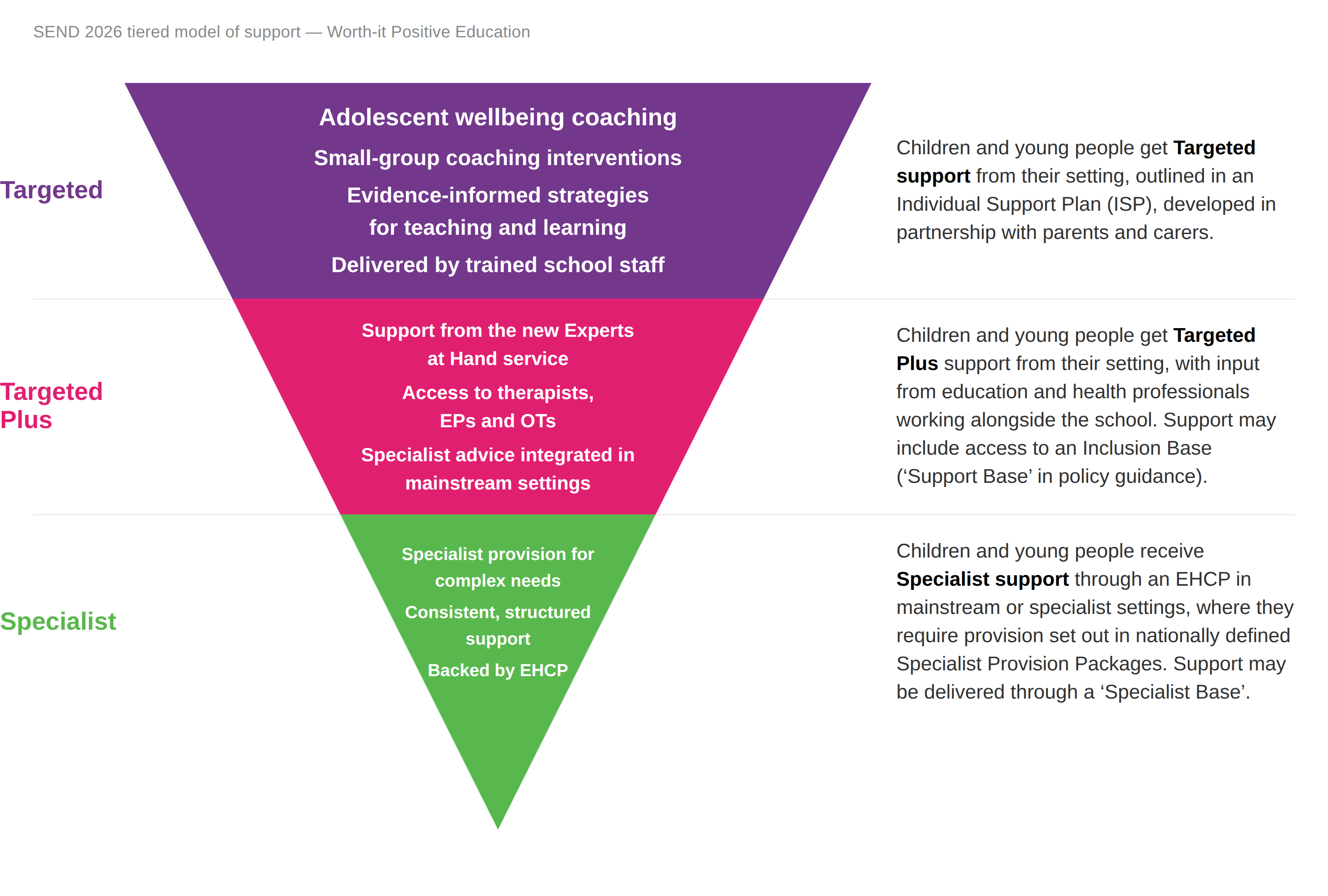
The second strand is the SENCO using coaching to develop colleagues. That might mean coaching a teacher who is finding it hard to adapt for a pupil, or a teaching assistant who wants to build a pupil's independence rather than do the work for them. It also means sharing coaching skills deliberately, so that listening well, asking rather than telling, and helping a pupil set their own next step become ordinary practice across the school.
This is not new territory for SENCOs. The SENCO standards already expect them to model effective practice and to coach and mentor colleagues. What reform changes is the scale. If whole-staff SEND training becomes a requirement, a SENCO who can coach, and who can grow a small team of in-house coaches, has a way to make that training stick in classrooms.
The two strands reinforce each other. A SENCO who coaches pupils builds credibility and practice wisdom to share with staff. Staff who learn coaching skills spot need earlier and respond better, which means fewer pupils reach the point of needing a formal intervention at all.
The evidence for coaching in schools is promising and growing, but it is uneven. SENCOs deserve a straight account of it.
Robson-Kelly and van Nieuwerburgh (2016) studied group and one-to-one coaching with young people aged 13 to 17 who were at risk of developing mental health problems, including young people with anxiety, low mood and self-harm, and an autistic young person. From interviews, focus groups and 80 self-reflective evaluations, they built a model of how coaching helps.
A trusting coaching relationship, combined with an engaging and adaptive programme, helped young people develop three groups of skills:
As their accountability grew, young people described greater choice and control over their thoughts, feelings and behaviour, more confidence, and a better ability to cope. Young people and coaches agreed that combining group work with individual coaching was the most effective format. For more about the impact of coaching read this artiicle.
Other studies point the same way. Senior students who took part in evidence-based life coaching showed gains in hope and hardiness (Green, Grant and Rynsaardt, 2007). A ten-session, teacher-facilitated coaching programme was followed by higher wellbeing and lower depression, anxiety and stress (Dulagil, Green and Ahern, 2016). At-risk adolescent girls reported positive changes in their lives after an integrated coaching and positive psychology group programme (Pritchard and van Nieuwerburgh, 2016).
The evidence for coaching teachers is stronger. A meta-analysis of 60 studies found coaching improved teachers' instruction and raised pupil achievement, with the biggest effects in smaller, focused programmes (Kraft, Blazar and Hogan, 2018). In a randomised trial, teachers who received coaching showed greater goal attainment, lower stress, and better workplace wellbeing and resilience than those who did not (Grant, Green and Rynsaardt, 2010). Coaching skills also travel: in van Nieuwerburgh and Tong's (2012) study, young people who were trained to coach others benefited themselves.
Coaching for pupils with SEND is an emerging practice, growing because schools need new responses to rapidly changing demands. Schools cannot wait for large trials to catch up with the reforms. Instead, the evidence needs to learn from practice.
That means implementing coaching well: match it to identified need, baseline and measure outcomes, record SEND pupils' results separately, and review it through the graduated approach. Every school that does this is building the evidence base, not just drawing on it.
Worth-it's Adolescent Wellbeing Coach Training was built to do both jobs: equip practitioners to coach young people directly, and give them a method they can share with colleagues. It is grounded in the Robson-Kelly and van Nieuwerburgh (2016) model, alongside positive psychology, coaching psychology and Self-Determination Theory.
Many SENCOs will find Stage 1 is enough to use coaching confidently in their role. Stage 2 suits those who want to lead a school's coaching offer and disseminate coaching approaches within their school culture.
Mapped against the Inclusive Mainstream Fund's best-practice themes, coach training contributes most directly to early, evidence-based support; high-quality teaching; enriching provision; belonging and attendance; and inclusive environments. Those areas sit alongside Ofsted's inclusion, attendance and behaviour, personal development and curriculum evaluation areas.
Two cautions make the case stronger, not weaker. Inspectors will want to see that training changes classroom practice, so capture staff self-assessment before and after. And whole-school data is not enough for SEND: record coaching outcomes for pupils with SEND separately.
SEND reform will not succeed by asking SENCOs to do more of the same. It needs them to work differently: reaching pupils earlier, and building the confidence of every adult around those pupils. Coaching does both. It is not a statutory requirement and it is not a cure-all, but it is one of the few professional development routes that grows a SENCO's capacity instead of consuming it.
If you are a SENCO, inclusion lead or headteacher planning how to use this year's SEND training and Inclusive Mainstream Fund allocation, consider three questions:
Find out more: explore Worth-it Adolescent Wellbeing Coach Training, download the coach training prospectus, or start with our free CPD course, Introduction to Coaching Young People.



LAST UPDATED:
October 14, 2026
Discover how coaching builds SENCO capacity for early intervention and staff development, and how accredited coach training can help.

LAST UPDATED:
October 12, 2026
Get your questions answered and find out more about our Worth-it Coach Training Course by reading this in-depth article


.svg)


