✖

Updated:
September 21, 2026
Written By:
Liz Robson
If you've read the updated Ofsted framework, a recent DfE guidance document, the government white paper on SEND reform or your own school's wellbeing and inclusion policy recently, there's a good chance you've come across the phrase "targeted support." And there's an equally good chance nobody has ever actually explained what it means in practice.
You're not alone in finding this frustrating. "Targeted support" is one of those terms that gets used confidently in policy language and inspection frameworks, but rarely gets translated into something a busy pastoral lead, SENCO, or assistant head can actually act on. This guide is here to change that: a clear, practical explanation of what targeted support means, what it looks like day to day, and where to start if your school needs to introduce more of it.
"Targeted support" comes from a wider framework used across education and mental health policy to describe different levels, or tiers, of support a school provides. You'll see it referenced in DfE and Anna Freud guidance on mental wellbeing support, and it's increasingly a term Ofsted inspectors expect schools to be able to speak to confidently when discussing their approach to pupil wellbeing and inclusion.
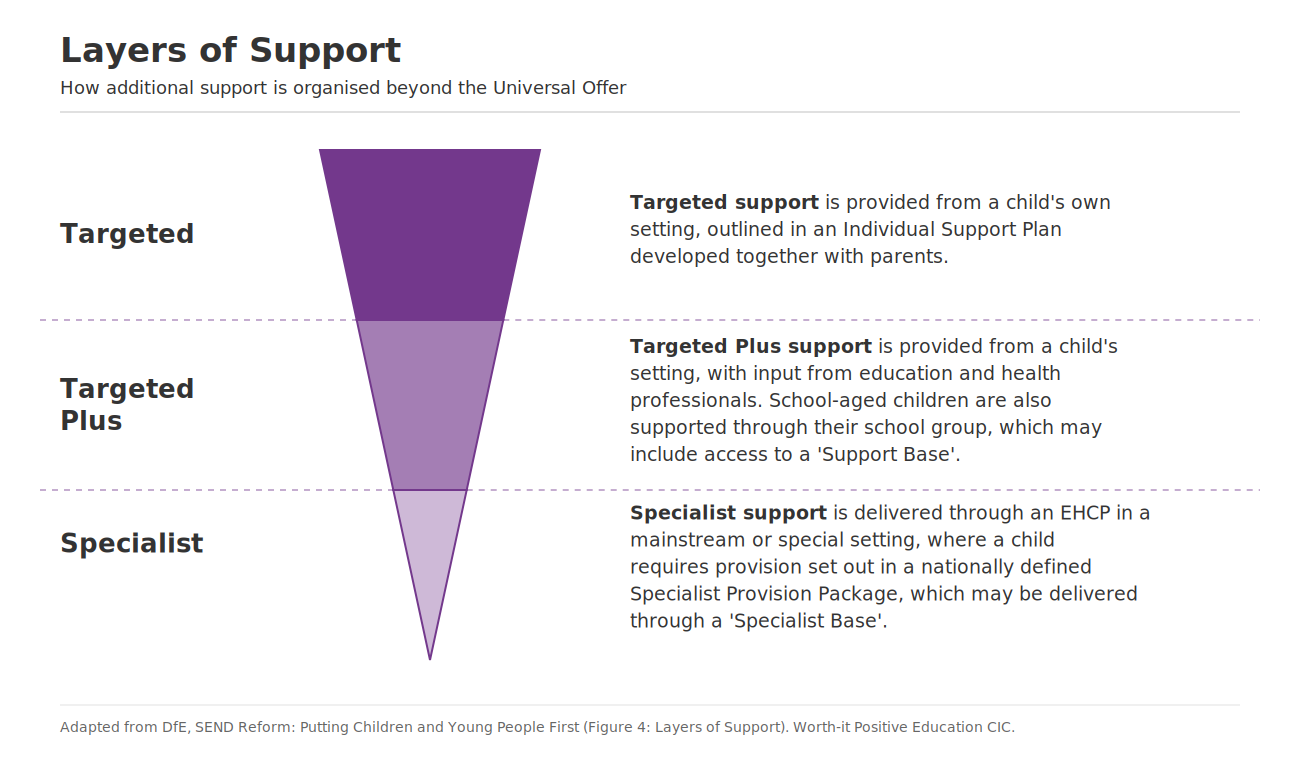
It's also been given a much sharper definition recently. The government's SEND reform plans set out a "one education system" built around a universal offer of high-quality teaching and support for all children, from early years to age 25, backed by £1.6 billion of investment over three years to make mainstream schools more inclusive. For children who need additional help, support is organised across two further layers: Targeted (including Targeted Plus) and Specialist. Targeted, including Targeted Plus, provides structured, evidence-based interventions within mainstream schools, drawing on services like Experts at Hand to bring in education, health and care professionals where needed. Specialist support, delivered through new Specialist Provision Packages, is reserved for children with the most complex needs and underpins Education, Health and Care Plans (EHCPs). Every child receiving Targeted, Targted Plus or Specialist support will have an Individual Support Plan, developed collaboratively with parents, describing their day-to-day provision.
The confusion usually isn't about whether targeted support matters, most schools instinctively know it does. It's about where it sits, what distinguishes Targeted from Targeted Plus and from Specialist provision, and what a school is actually meant to be doing differently to deliver it.
The clearest way to understand targeted support is to see it as the middle layer of a three-tier model:
Universal support is what every pupil receives, regardless of need. This includes whole-school PSHE curriculum, assemblies on wellbeing, a positive school culture, and general pastoral care available to anyone.
Targeted support is for pupils who are showing early signs of difficulty, or who sit in a recognised risk category, but who don't yet need, or don't meet the threshold for, specialist clinical intervention. This might include pupils experiencing early anxiety, low mood, disengagement, attendance difficulties, or who are navigating disadvantage, trauma, or a difficult home situation. Targeted support is proactive rather than reactive: the goal is to intervene early, before difficulties escalate into something that requires clinical support.
Specialist support is for pupils with diagnosed or more severe mental health needs, typically delivered by CAMHS, educational psychologists, or other clinically trained professionals, often via referral.
Most schools are confident delivering universal support, and most understand when a referral to specialist support is needed. Targeted support is the layer in between that causes the most uncertainty, because it's the one most schools haven't been given a clear, practical toolkit for.
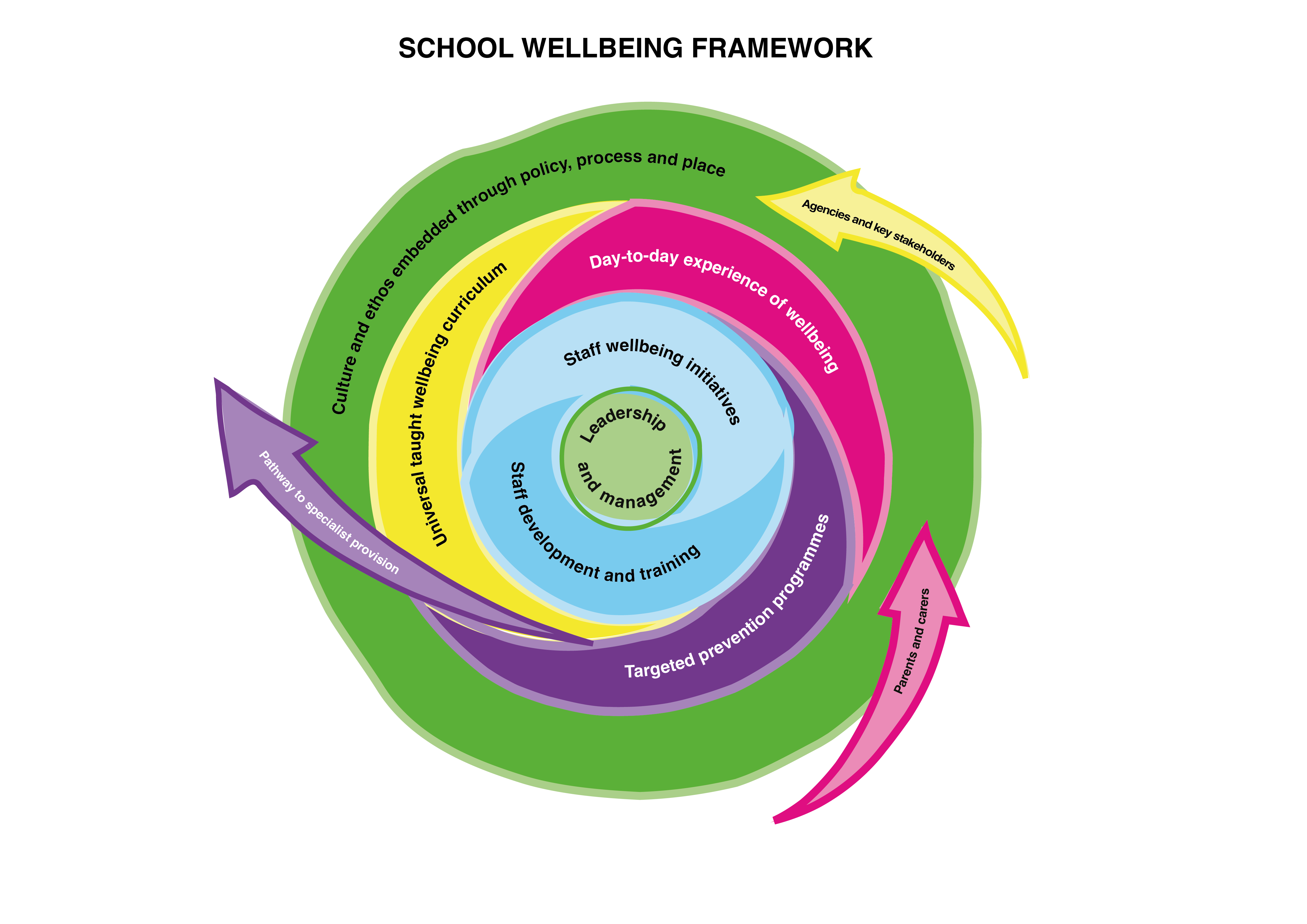
In this diagram you can see where universal, targted support and early prevention and pathways to speclaist provision sit within our school wellbeing framework.
If you've come across "Targeted Plus" and weren't sure how it differs from ordinary Targeted support, you're reading the right term at the right moment. Under the government's SEND reform plans, Targeted support isn't a single, flat category, it's a layer with its own internal range.
Targeted covers structured, evidence-based interventions a school can put in place within its own mainstream setting, for a pupil or small group who need more than the universal offer but don't require multi-agency or specialist involvement.
Targeted Plus sits at the more intensive end of the same layer. It's still short of Specialist provision, but it draws in additional support, through services like Experts at Hand, to bring education, health and care professionals into the picture where a pupil's needs are more complex.
In practice, this matters for two reasons. First, every child receiving Targeted or Targeted Plus support will need an Individual Support Plan, developed with parents, setting out their day-to-day provision, so schools need a clear, consistent way of identifying who that applies to and what's actually being delivered. Second, it reinforces a point pastoral teams already sense: a lot of genuine need sits in this Targeted band, below the threshold for Specialist Provision Packages and EHCPs, but well above what universal provision alone can address. That's precisely the space schools are being asked to build sustainable, in-house capacity for, rather than relying solely on stretched specialist services.
In practice, targeted support can take many forms, but it generally shares three features: it's proactive rather than reactive, it's for a specific pupil or small group identified as needing more than universal support, and it doesn't require a clinical diagnosis or a CAMHS referral to begin.
Examples schools already use include small-group interventions for anxiety or emotional regulation, structured mentoring for pupils flagged as at risk of disengagement, nurture groups for younger pupils, and one-to-one check-ins for pupils going through a difficult period. What's less commonly recognised, and this is worth sitting with, is that structured coaching for young people fits this definition closely. It's proactive, it's for pupils identified as needing more than universal provision, and it operates entirely outside a clinical framework.
You likely already have signals that targeted support is needed, even if nobody has labelled them that way. Rising attendance concerns among a specific group of pupils. Pastoral staff repeatedly flagging the same names in weekly meetings. Pupils who are clearly struggling but don't meet the threshold for a CAMHS referral, and end up falling into a gap where nothing structured happens until things get worse. A safeguarding or wellbeing lead who is stretched thin trying to personally hold every at-risk pupil's ongoing support.
If any of that sounds familiar, your school likely already needs targeted support, it just may not have a structured, resourced way of delivering it yet.
The most common mistake is trying to stretch universal provision to cover targeted need, running more assemblies, adding more PSHE content, when what's actually needed is something more individualised. The second is assuming targeted support requires clinical training or an external referral pathway, when in reality much of it can be delivered by trained school staff using structured, evidence-informed approaches. The third is treating it as a short-term fix rather than building sustainable, in-house capacity, bringing in an external practitioner for a term, rather than developing a lasting, whole-school approach delivered by people who already know the pupils and the context.
The most useful first step isn't a new policy document, it's an honest audit. Ask your pastoral and wellbeing team three questions: Which pupils are we already worried about, who aren't at a level requiring clinical referral? What are we currently doing for them, if anything, beyond universal provision? And do we have the internal capacity and skills to deliver something more structured, or are we relying on stretched staff doing their best without a clear framework?
That audit alone usually clarifies where the gap actually sits, and what kind of intervention would close it.
If you are looking for a place to start use our Wellbeing and Inclusion Planning Tool to identigy your starting points and priorities.
It helps to know that this isn't a single "go-live" moment schools need to scramble to meet. The Government has set out SEND reform as a phased rollout, and as of September 2026, much of the detail, including the National Inclusion Standards and a revised SEND Code of Practice, is still to be finalised. The milestones below should be read as a direction of travel for planning purposes, not a fixed statutory deadline, since the Government itself says the timeline remains subject to change as legislation passes through Parliament.
2026–27: the preparation year (where most schools are now). This is the year to build foundations, not finish them. Practical steps include auditing your current provision, honestly, which pupils are already flagged as struggling but sit below the threshold for an EHCP, and what, if anything, is currently in place for them at the Targeted level. It's also the point to start developing your Universal Offer, and, critically, to begin building staff capability, because training people to deliver structured targeted interventions well takes months, not weeks. If you're planning to build in-house capacity through coach training, this is the year to start it: a full accredited coach training programme typically takes 6 to 9 months to complete, so starting a cohort now means your school has trained, accredited coaches in place well before wider implementation ramps up.
2027–28: increasing implementation and funding. More of the new funding infrastructure, including the Inclusive Mainstream Fund, is expected to expand. Schools that used 2026–27 well should now be moving from "planning" to "embedding," using early cohorts of trained staff to expand targeted provision, and starting to test how an Individual Support Plan process might work in your setting.
2028–29: the Government's stated target for full implementation. By this point, schools should expect the Universal Offer, Targeted support, and referral routes to Targeted Plus and Specialist provision to be operating as a more integrated system, with an annual Inclusion Strategy in place rather than the current SEN Information Report. Schools that built genuine in-house targeted-support capacity from 2026–27 onwards will be far better placed here than those relying on short-term, external interventions bought in at the last minute.
2029–30: the full breadth of Universal, Targeted, Targeted Plus and Specialist support expected to be operating system-wide. This is the point the reform is ultimately aiming for. The practical implication for schools is straightforward: the earlier you start building sustainable in-house capacity to deliver targeted support, the less disruptive, and the less costly, this transition will be.
The throughline across every phase is the same: the Government's direction of travel consistently favours building capacity within schools over relying on specialist services to intervene after problems have escalated. Whatever your starting point, the practical priority for 2026–27 is the same, start building that capacity now, while there's time to do it properly.
One of the most effective, and most overlooked, ways to build capacity at the Targeted tier is coaching, specifically, adolescent wellbeing coaching. It's an intervention designed for exactly this layer: early, proactive support for young people whose needs go beyond what universal approaches can address, but who don't require, or don't yet require, specialist or clinical intervention.
That includes young people facing a wide range of barriers to learning, disadvantage, difficult home circumstances, low confidence, disengagement, or any challenging situation that's starting to affect their attendance or attainment. These are pupils schools already recognise, the ones pastoral teams are watching closely, who sit squarely in the Targeted, and sometimes Targeted Plus, space.
To be clear: adolescent wellbeing coaching is not a substitute for specialist or clinical support. It doesn't replace CAMHS, educational psychology input, or multi-agency involvement where a young person genuinely needs it, and coaches are trained to recognise when a referral is the right next step rather than continuing to coach. What it does is increase a school's capacity to intervene early, at the Targeted level, before difficulties escalate into something more serious, long-term, or enduring, and before they result in the young person needing specialist support at all. Research into this approach (Robson-Kelly & van Nieuwerburgh, 2016) found that coaching helps young people build trust in a relationship with a trusted adult, develop key skills, and grow the accountability and self-awareness that leads to real improvements in confidence, coping, and wellbeing, precisely the kind of early, preventative impact the Targeted tier is meant to deliver.
The strongest way to introduce adolescent wellbeing coaching into your school isn't to bring in an external practitioner for a term and then lose that capacity when the contract ends. It's to build the capability in-house, training your existing pastoral staff, the people who already know your pupils, your context, and your community, to become accredited adolescent wellbeing coaches themselves.
That approach gives you something most short-term interventions can't: sustainable, embedded capacity to deliver targeted support, year after year, reducing how often pupils' needs escalate to the point of requiring specialist provision, without depending on external providers or a shrinking specialist workforce that's already stretched thin.
If that's a gap you're recognising in your own school, it's worth finding out more about how adolescent wellbeing coach training works, and how it could fit into the pastoral capacity you already have.
Refrences
Department for Education & Anna Freud National Centre for Children and Families. Developing your school or college's targeted mental wellbeing support: A framework for guiding effective decision making.
Ofsted. (2026). School inspection toolkit: for use from September 2026. GOV.UK / Ofsted.
Department for Education. (2025). SEND reform: Putting children and young people first. GOV.UK.
Robson-Kelly, L., & van Nieuwerburgh, C. (2016). What does coaching have to offer to young people at risk of developing mental health problems? A grounded theory study. International Coaching Psychology Review, 11(1), 75–92.



LAST UPDATED:
September 21, 2026
Discover how coaching can empower disadvantaged students by building resilience, fostering wellbeing, and providing targeted support.

LAST UPDATED:
September 21, 2026
Teen life coaching and adolescent wellbeing coaching aren't the same. Here's the difference, and why it matters for targeted school support.


.svg)


