✖

Updated:
September 23, 2026
Written By:
Liz Robson
Inclusion bases are one of the most promising developments in mainstream education right now. They give pupils with additional needs a safe, supportive place to regulate, reconnect and access help without losing their place in the wider school. Yet many leaders quickly hit the same wall: the space is ready, the referrals are coming in, but the staffing simply cannot keep pace with the need.
This guide explores a practical, affordable way to close that gap. Rather than waiting for a specialist headcount you cannot easily or afford to recruit, you can build the skills you need within the team you already have.
Here is what you will find in this guide:
Before exploring what Coach Training offers, it helps to be clear about where it fits. The DfE's inclusion bases guidance describes provision operating across three layers.
Tier 1 is the universal whole-school offer: culture, belonging, and peer relationships that benefit every pupil. This is where the peer support programme Wellbeing Ambassadors sits, creating visible, low-barrier routes into support and reducing stigma across the whole school community, including for pupils accessing a base.
Tier 2 is targeted, structured, individual support for identified pupils facing specific barriers. This is where Coach Training sits. It is an evidence-based intervention designed for the pupils who need more than the universal offer, but whose needs are not solely clinical.
Tier 3 is specialist clinical provision: speech and language therapy, occupational therapy, CBT, CAMHS, psychotherapy. These require professionally qualified clinicians and address diagnosed clinical needs.
The inclusion bases guidance is explicit that provision needs to operate across all three tiers. Coach Training fills the targeted tier in a way that is evidenced, accredited and sustainable, addressing the personal development outcomes the guidance says every base must deliver, but that many bases currently struggle to provide in a structured, consistent way.
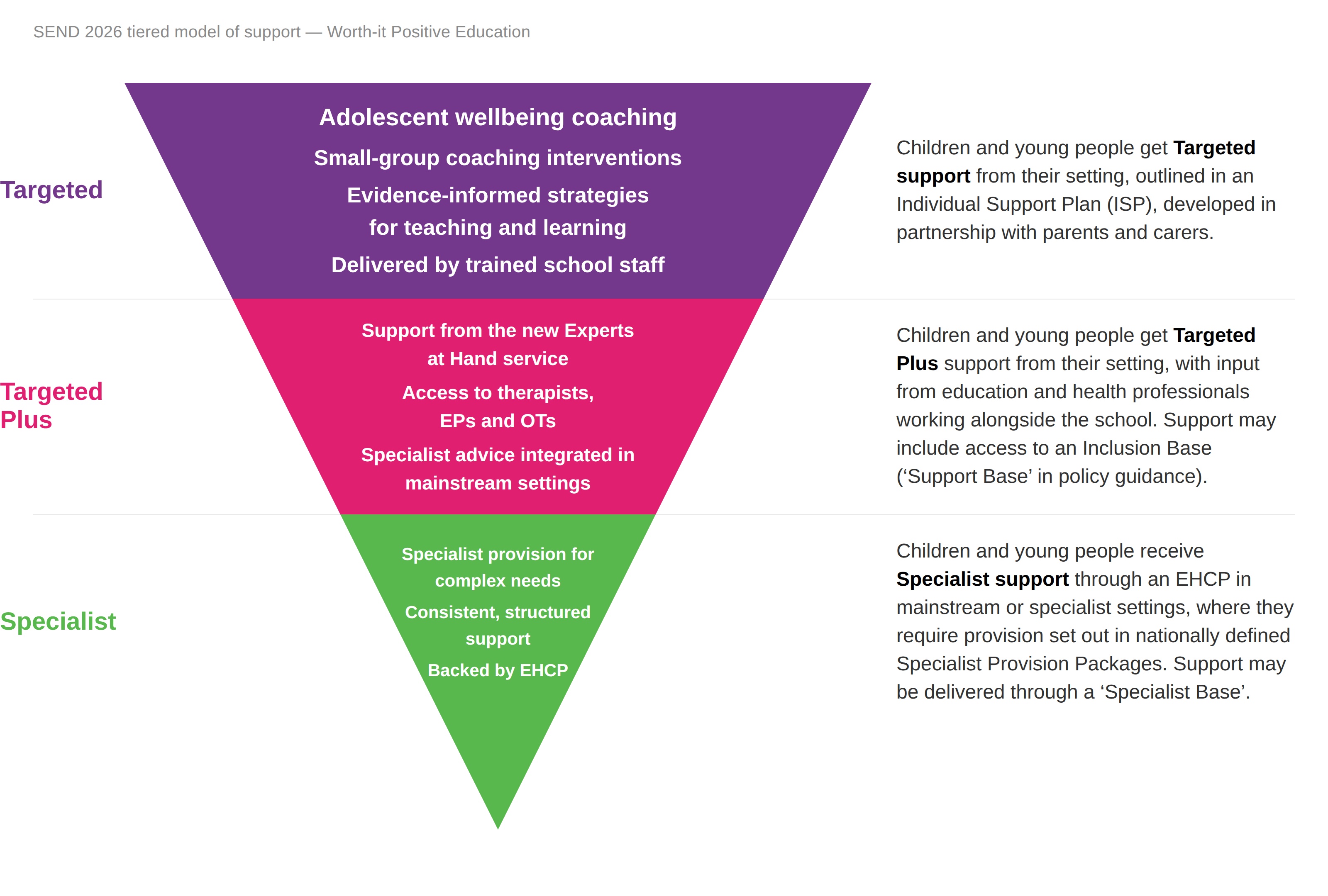
The DfE's inclusion bases guidance sets out an ambitious vision, backed by significant capital investment. But capital funds buildings, not people. The harder constraint is almost always the workforce.
Clinical or SEND specialists such as speech and language therapists, occupational therapists, educational psychologists and CAMHS practitioners are scarce, costly, have long waiting lists and are booked out months ahead. Most bases simply cannot recruit their way to full coverage.
That leaves a widening gap in the middle. On one side sits universal whole-school provision. On the other sits specialist clinical referral. In between is the Tier 2 layer of targeted support, and this is exactly where many pupils in a base need the most help.
Common signs your base is feeling this pressure:
Key point: The biggest driver of need in most bases is not something that requires a clinician in the room. It requires a trained member of staff who already knows the pupils.
Look beneath the label on a referral form, whether it says SEMH, at risk of exclusion or persistent absence, and you usually find the same cluster of internal barriers. They show up across very different pupil groups with striking consistency.
These barriers are not fixed traits. They interact and compound. Systemic pressure worsens anxiety, which drives withdrawal, which reduces attendance. Left unaddressed, they surface as the three things every base is trying to fix: falling attendance, escalating behaviour and stalled progress.
The good news is that these are precisely the barriers that structured, relational, goal-focused work can shift. Addressed early through a consistent, trusted adult, they respond well to change.
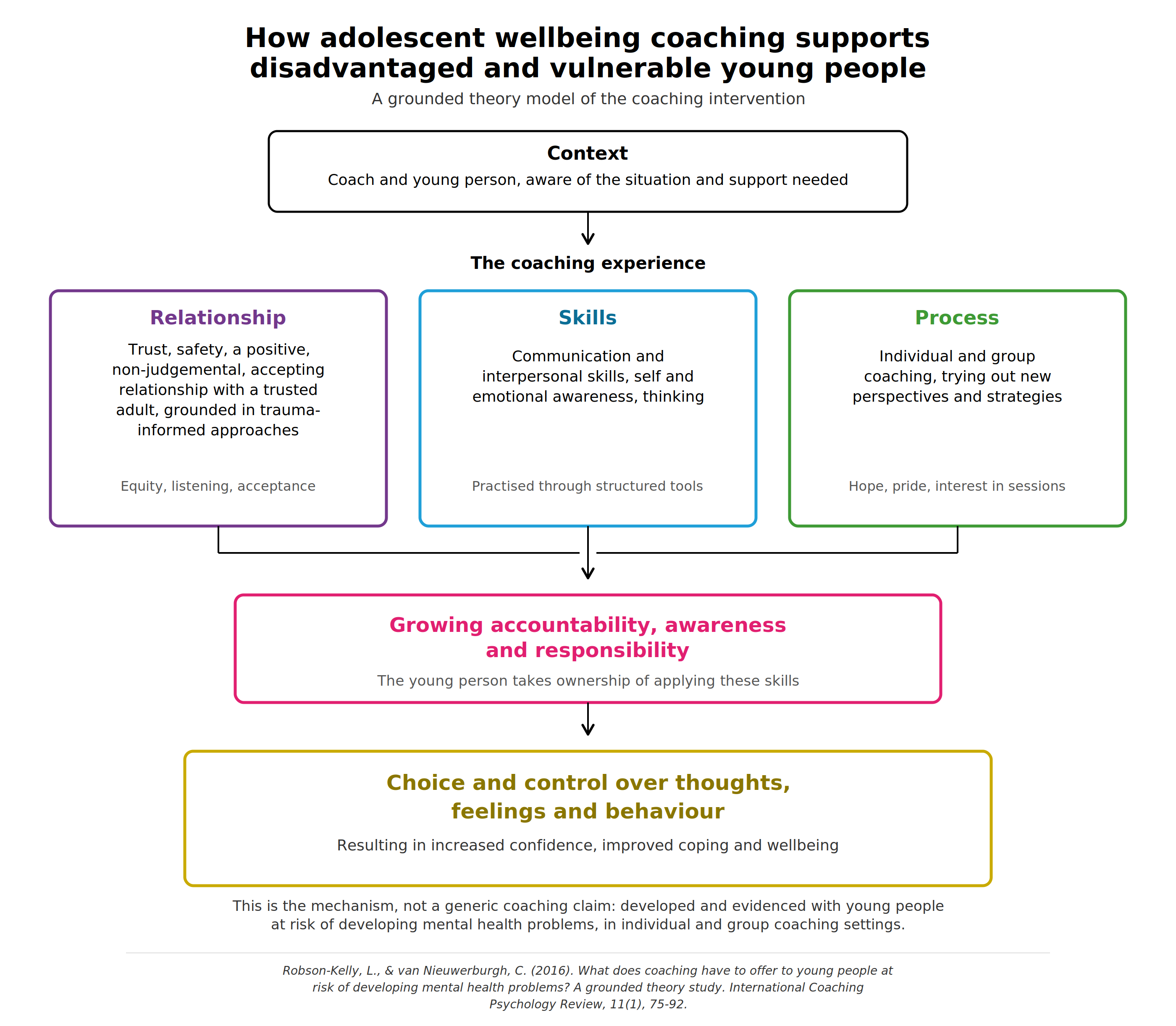
Student Wellbeing Coaching builds resilience and positive coping strategies before difficulties become entrenched.
The solution-focused approach at the heart of Worth-it's Coach Training is built around the question the DfE guidance asks staff to ask: what is getting in the way, and what would it look like if it were not there? Coaching also names transitions as a core focus, supporting pupils whether they are changing schools, returning after absence or navigating their school day. The guidance calls specifically for "careful planning to ensure children feel safe and supported during transitions," and a trained base staff member who can provide structured one-to-one coaching at those moments becomes a concrete way to meet that requirement.
Confidence, independence and a sense of belonging are overarching aims that run through everything a base does. All three are explicit outcomes of the coaching process, built through the young person's own goal-setting, self-reflection and skill development across repeated sessions with a consistent, trusted adult.
Because student wellbeing coaching targets the underlying psychological barrier rather than a specific diagnosis, one trained skill set supports a genuinely broad range of pupils. The same approach helps a pupil returning after absence, a young person at risk of exclusion, and a disadvantaged pupil rebuilding their sense of belonging.
Try this now: Think of three pupils currently in your base. How many share low self-belief, anxiety or disconnection? That overlap is your case for coaching.
Worth-it's Coach Training equips your existing staff with an accredited, evidence-based coaching method built specifically for young people aged 13 and over who face disadvantage and emotional barriers.
Here is what the programme includes:
The training is graduated. Part 1 gives whole teams foundational coaching skills, while Part 2 develops a smaller number of staff to full accreditation. This mirrors the DfE guidance's graduated approach to workforce development, with broad competence across the team and pockets of deeper expertise sitting alongside it. The training can be delivered for teams across your school or trust or for individual members of staff who can join our open Coach Training Programmes, in Autuum and Summer.
The programme is designed for the people already in your school: pastoral staff, SENCOs, teachers, teaching assistants, mentors and support workers. Once trained, staff hold the method and the toolkit indefinitely, and the reflective logs built into the accreditation create a structured, ongoing record of pupil progress that quality assurance reviewers and Ofsted can see.
One clear boundary to state: the Worth-it coaching model assumes verbal communication and reflective capacity. It is not designed for preverbal learners or those with profound and complex communication needs, for whom specialist SaLT input remains primary.
The DfE's inclusion bases guidance sets out six principles of effective practice. Coach Training maps directly onto most of them.
Supporting inclusion in the school: Coaching identifies and works through the internal barriers that block a pupil's participation in mainstream life, including poor self-awareness, difficulty with transitions and a sense that school is not a place where they belong. These are the barriers the guidance asks staff to actively look for and remove.
High-quality curriculum design: The guidance requires bases to develop broader life skills and embed preparation for adulthood, not just academic progress. The three outcome domains of the Worth-it coaching model, which are interpersonal and relationship skills, self and emotional awareness, and thinking skills including goal-setting and problem-solving, match directly to what the guidance means by this strand. Coaching is not a tool for adapting the National Curriculum for complex SEND learners, but it provides the structure for the personal development strand that bases often find hardest to deliver consistently.
Effective data, assessment and outcomes: The guidance requires tracking of engagement, wellbeing, confidence, social relationships and belonging, and it acknowledges that progress for many base pupils involves "small-step, non-linear trajectories." The reflective coaching tools built into the training create exactly this evidence record, session by session, in the young person's own voice.
Effective workforce and leadership: Coach Training runs over 6 to 12 months, is externally accredited, underpinned by published research, and includes 20 hours of coaching practice with reflective logs. It meets every requirement the guidance sets out for high-quality, sustained, evidence-informed CPD. The coaching relationship itself, boundaried, consistent and focused on the young person's goals, is a model of the psychological safety and consistent key adult the guidance specifically calls for.
Effective partnership working: Coaching methodology puts the young person at the centre of every session. They set the agenda, identify their goals and determine what success looks like. This makes pupil voice genuinely operational in provision planning, not just recorded on a form.
Inclusive and accessible physical environments: Coaching needs only a quiet, private space and a skilled adult. No specialist equipment is required. A coaching session is structured, calm and predictable, which itself creates an accessible environment for pupils whose anxiety makes unpredictability difficult to manage.
One of the most important and often overlooked roles for student coaching in a base is at the reintegration point. The guidance is clear that schools should consider opportunities for pupils to move along the continuum toward greater participation in mainstream, with evidence-informed criteria for doing so.
The internal barriers that most commonly prevent this movement are lack of self-belief, fear of failure, difficulty managing new social situations and poor self-awareness about personal triggers. These are exactly what structured coaching addresses. A young person who has developed goal-setting skills, positive coping strategies and a stronger sense of their own competence is better equipped to sustain reintegration than one who has simply been gradually exposed to mainstream classes without any parallel work on the internal experience of doing so.
Because coaching addresses internal psychological barriers rather than a specific diagnosis, a small number of trained coaches can support a genuinely broad cross-section of pupils accessing a base.
Pupils with SEMH needs: The most direct alignment. Published research specifically underpins the approach with this group. Coaching builds resilience and coping strategies before difficulties become entrenched, which is precisely what targeted Tier 2 SEMH support is designed to do.
Pupils at risk of exclusion: Coaching addresses disempowerment and dependence, the two psychological states most associated with escalating behaviour. Goal-setting and accountability give young people a different framework for understanding their own situation.
Pupils with persistent absence or emotional barriers to attendance: Returning after absence is a named coaching use case. The structured, relationship-based, low-pressure format of a coaching session can rebuild the connection to school that attendance requires.
Looked-after children and those facing social disadvantage: Worth-it's founding purpose since 2009 has been coaching young people facing social disadvantage. Published research specifically addresses this group, providing the evidence base the guidance requires for all targeted approaches.
Pupils with EHC plans: Coaching does not replace clinical input or specialist curriculum adaptation. However, many EHC plan outcomes include personal development, independence and communication goals, which coaching develops directly. A young person receiving both SaLT or OT and coaching is getting coordinated support across clinical and personal development domains rather than clinical input alone.
Post-16 and NEET risk: For post-16 settings, coaching is particularly well matched. Employability, self-management, goal-setting, resilience and forward planning are all coaching outcomes, and they are the outcomes that most directly determine whether a young person leaving a base enters employment, education or training.
Autistic pupils: Coaching's structured, boundaried, consistent and predictable format suits many autistic learners well. The self-awareness and interpersonal skills developed through coaching also support social participation in mainstream settings. The boundary to note again is that the model assumes verbal communication and reflective capacity.
The difference between buying in sessions and training your own staff is the difference between renting and owning.
External provision often works well while it lasts, but it stops the moment the funding does, and it rarely builds anything that stays in your school. Coach Training flips that model.
Key point: Every member of staff you train adds permanent capacity to your base, year after year, at a fraction of the cost of ongoing external delivery.
The Inclusive Mainstream Fund is designed to help schools move towards practices that are inclusive by design, with a clear focus on early, evidence-based support and building staff capacity. The DfE guidance explicitly allows funding to be spent on staff training and CPD that develops the workforce to deliver evidence-based provision.
Coach Training aligns directly with several of the seven IMF themes.
Crucially, this is a defensible spend because it is accredited, evidenced and inspectable. Instead of "we run some wellbeing sessions," you can point to an externally accredited standard, a published research base and documented pupil progress captured in reflective logs. It also represents a small proportion of a typical IMF allocation, leaving room for your other inclusion priorities.
A Simple Way to Frame the Business Case
If you are writing coaching into your inclusion strategy, keep the argument clear:
If you are not sure which programme is the best way forward for your school use our Free Wellbeing and Inclusion Planning tool.
Inclusion bases do not need a specialist for every presenting need. They need the staff who already know the pupils, equipped with a proper method for the barrier that sits behind most referrals: the internal one.
Coach Training fills the Tier 2 gap that most bases currently have no structured way to address. It sits alongside Wellbeing Ambassadors at Tier 1 and specialist clinical provision at Tier 3 to create a joined-up, sustainable inclusion system, rather than a collection of disconnected interventions. And it gives you accredited, inspectable evidence for your IMF-funded inclusion strategy.
Try this first: map three of your base pupils against the shared barriers in this guide, then identify which staff could be trained to support them. From there, you have the start of a clear, fundable plan.
To see how the programme could work in your setting, find out more about Worth-it Coach Training and take the first step towards an inclusion base that truly supports every pupil.


.jpg)

LAST UPDATED:
October 7, 2026
Discover what an adolescent wellbeing coach does, how coaching provides targeted early support in schools and colleges.

LAST UPDATED:
September 30, 2026
Confused by "targeted support" or "Targeted Plus"? A clear, practical explainer for school staff on what these mean, and where to start.


.svg)


