✖

Updated:
September 14, 2026
Written By:
Liz Robson
If you've spent any time looking into coaching as a form of support for young people, you'll have noticed a problem before you even get to evaluating a single provider: the word "coaching" means too many different things.
It's used for confidence-building, for exam performance, for sports ,for personal development, and we're suggesting for early mental health prevention. Some of it is delivered by qualified psychologists working from a published evidence base. Some of it is delivered by well-meaning practitioners with no defined methodology at all. Both call themselves "coaches."
For a school leader, SENCO, or wellbeing lead trying to work out whether coaching belongs in a targeted support offer, that ambiguity is the real obstacle. You can't evaluate quality or fit if you can't first tell two fundamentally different things apart. This article draws that distinction, explains why it matters specifically for early intervention in schools, and grounds the case in what the published research actually shows.
Coaching in education has grown enormously over the last two decades, and it now shows up in a wide range of forms: coaching for leadership development, coaching between peers, coaching from parents, and coaching delivered directly to students. Even within that last category alone, there's enormous variation in what "coaching" actually involves.
Some providers offer a loosely structured, confidence-and-goals conversation, adapted from techniques developed for adult or executive coaching. Others have built something more deliberate: a coaching approach designed specifically around adolescent development, grounded in psychological theory, and aimed explicitly at prevention rather than general self-improvement.
These aren't the same product, and treating them as interchangeable is where schools run into trouble. That's the distinction this article draws out: teen life coaching versus adolescent wellbeing coaching.
Teen life coaching is best understood as a broad category rather than a defined methodology. It typically focuses on personal growth, confidence, goal-setting, and individual development, delivered one-to-one by a practitioner.
To be clear: this isn't a quality judgement. There are excellent, thoughtful practitioners working under the "teen life coach" label, and plenty of young people benefit from that kind of support. The issue isn't the people. It's the label itself, which doesn't tell you anything about the methodology underneath it.
A teen life coach might be working from a clearly defined psychological framework, or might not be. They might have built their approach specifically around how adolescents develop, or might be applying techniques originally designed for adult clients. Because the category is so broad, a school evaluating "teen life coaching" as an option has no reliable way to know what they're actually getting until they dig into a specific provider's methodology in detail.
Adolescent wellbeing coaching is a narrower, more specific claim. It describes coaching that is:
This is a specialism, not a rebrand of the same thing. And unlike a lot of language in this space, it isn't just a positioning claim — there's a published evidence base behind what this kind of coaching actually does and why it works.
.png)
UK guidance on school-based mental health support describes a middle tier sitting between universal pastoral care (available to every student) and specialist or clinical referral (CAMHS, Mental Health Support Teams). This middle tier targeted support, is meant to offer early, preventative help to individuals or groups showing signs of difficulty, before things reach crisis point.
Inspection frameworks reward exactly this kind of provision: support that's "well matched to pupils' needs" and addresses "underlying issues... to prevent problems recurring," rather than short-term fixes.
Generic teen life coaching may do genuinely good work, but it wasn't necessarily designed to answer that brief. Adolescent wellbeing coaching was. Its prevention orientation, its grounding in adolescent development specifically, and its explicit attention to vulnerability and disadvantage make it a much closer conceptual fit for the targeted support tier than a general confidence-and-goals coaching conversation.
It's worth grounding this in real evidence rather than description alone. A 2016 UK study (Robson-Kelly & van Nieuwerburgh, published in the International Coaching Psychology Review) used grounded theory to examine exactly this question: what does coaching actually offer young people at risk of developing mental health problems?
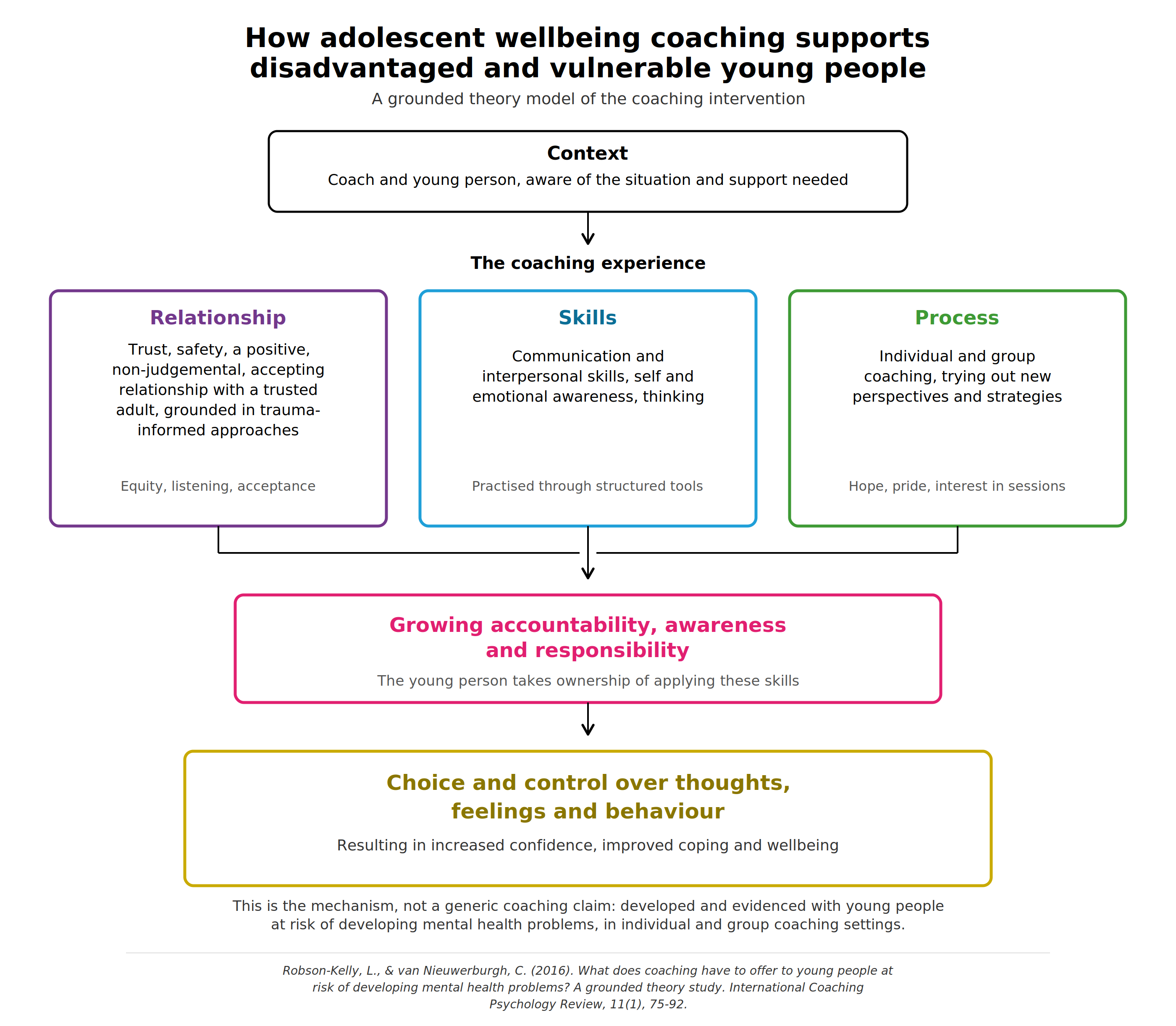
The study's model identifies three interlocking elements that make up the coaching experience itself:
Together, these three elements did something specific: they built what the study calls growing accountability, awareness and responsibility in the young person, where they took ownership of applying what they'd learned to their own situation. That, in turn, produced the study's core finding: coaching helped young people develop choice and control over their thoughts, feelings and behaviour, resulting in increased confidence, improved coping, and better wellbeing.
This is a meaningfully different claim from "we help young people build confidence." It's a specific, evidenced mechanism: relationship and skills and process combine to build ownership, which produces psychological control, which produces wellbeing. That's what a genuinely evidence-grounded adolescent wellbeing coaching approach is actually doing underneath the surface.
If you're a school leader weighing up whether to introduce coaching as part of targeted support, these are the questions worth asking any provider:
A provider who can answer all six of these clearly is offering something different from a provider who can only answer the first one or two.
Not all coaching is targeted support, and not all targeted support needs to be clinical. But when coaching is being considered specifically for early prevention, the category worth looking for isn't "teen life coach." It's adolescent wellbeing coaching: evidence-informed, developmentally grounded, and built around prevention rather than general self-improvement. The distinction isn't semantic. It's the difference between a confidence-building conversation and a structured, evidenced intervention designed to help vulnerable young people build the psychological resources that protect their wellbeing before difficulties take hold.
Want a practical tool you can use straight away? Download our free workbook, How to Explain Resilience to a Young Person, a coaching-based resource designed to help you introduce resilience concepts to the young people you work with.
Curious how coaching could support your students, but not sure where to start? Our free CPD bundle, Introduction to Coaching Young People, gives you a grounded introduction to what coaching for targeted support actually looks like in practice.
Thinking about training your staff, or training yourself, to deliver it? Download our coach training prospectus, or visit our coach training page to find out more about our accredited adolescent wellbeing coaching training.
This article draws on published academic research on coaching in education, including Robson-Kelly, L., & van Nieuwerburgh, C. (2016). What does coaching have to offer to young people at risk of developing mental health problems? A grounded theory study. International Coaching Psychology Review, 11(1), 75–92; and UK Department for Education and NICE guidance on targeted support in schools.



LAST UPDATED:
September 14, 2026
Teen life coaching and adolescent wellbeing coaching aren't the same. Here's the difference, and why it matters for targeted school support.

LAST UPDATED:
September 14, 2026
Discover how inclusion bases can train staff to coach students boost capacity, and enhance targeted student in their school.


.svg)


