✖

Updated:
October 23, 2026
Written By:
Liz Robson
The Schools White Paper, Every Child Achieving and Thriving, sets out the government's ten-year vision for education in England. Its message is that achievement and wellbeing go together: schools are expected to help every child do well academically and thrive, with a strong sense of belonging.
For school leaders and pastoral teams, this is a significant shift. In this post we summarise what the White Paper says, explain what "achieving and thriving" and pupil progress mean in practice, and set out why belonging is the foundation for thriving at school, along with practical steps to prepare.
Every Child Achieving and Thriving was published by the Department for Education on 23 February 2026. It is a ten-year reform plan for schools in England, published alongside a consultation on SEND reform.
The White Paper is built around three shifts in children's experience of school:
Key proposals for schools include:
Many of these are proposals that will be developed and phased in over several years, so details may change.
Achieving is about learning and attainment: pupils gaining knowledge and skills, making strong progress and leaving school with qualifications that open doors.
Thriving is broader. A thriving pupil is doing well physically, emotionally, socially and intellectually. They feel safe, connected and motivated, and they are developing life skills such as resilience, problem-solving and self-regulation a positive sychology term we often use to describe this is flourishing.
The White Paper treats the two as inseparable. A pupil who is anxious, isolated or absent cannot achieve their potential, and a pupil who is achieving but unhappy is not thriving. Former Education Secretary Bridget Phillipson signalled this direction in 2024, saying thriving and belonging would feature "hand in hand with attainment".
Pupil progress means how much a pupil has learned and developed over time, compared with where they started. It is different from attainment, which is the level a pupil reaches at a point in time, such as their GCSE grades.
The distinction matters. A pupil who starts secondary school well behind and finishes with solid passes may have made far more progress than a pupil who started ahead and achieved top grades. At secondary level, schools' progress is measured nationally through Progress 8, which compares pupils' GCSE results with those of other pupils who had similar results at the end of primary school.
In an "achieving and thriving" approach, progress also includes growth beyond grades: attendance improving, confidence growing, friendships forming and engagement deepening. Schools in recent DfE research described tracking these alongside academic progress, and noted that progress measures often tell a fairer story than raw attainment for schools with many pupils who start from a lower base.
In practice, thriving at school means pupils who:
Schools nurture thriving by building on pupils' strengths, fostering a growth mindset, offering a broad curriculum and enrichment, and teaching social and emotional skills such as empathy, communication and resilience.
Belonging is where thriving starts. When pupils feel accepted, respected, included and supported at school, they are more likely to attend, engage and achieve, and they are better protected against mental health difficulties.
The evidence in England is strong and recent:
DfE case studies of schools with high belonging, attendance and attainment found that these schools saw belonging, attendance and achievement as a virtuous cycle, not competing priorities. That is the "achieving and thriving" idea in action.
For more on the links with attendance and attainment, read School belonging: how it helps pupils attend, achieve and thrive.
Belonging matters for staff too. Schools in the DfE research said staff cannot create belonging for pupils unless they feel it themselves, and staff who feel valued are better placed to support pupils.
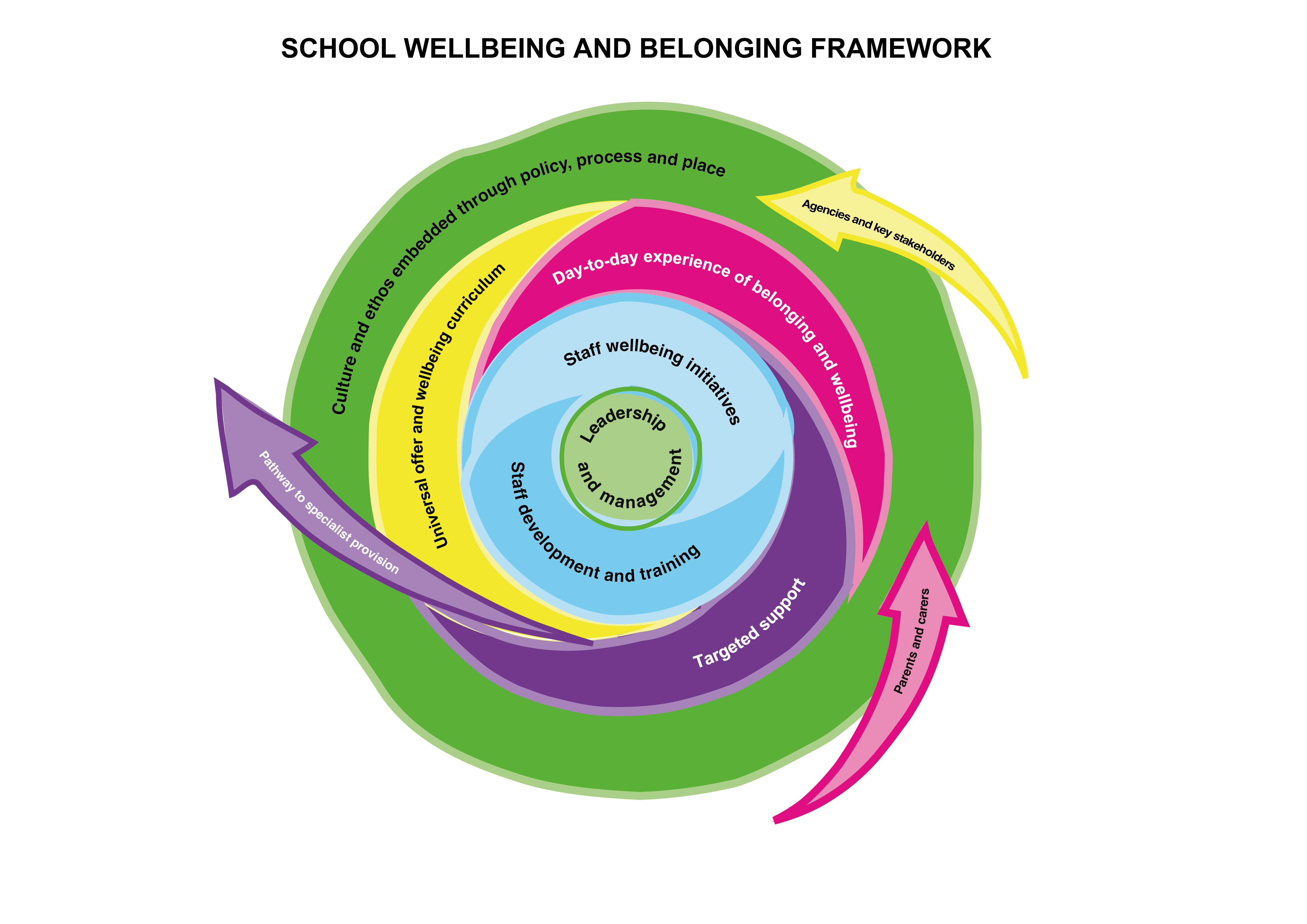
Inclusion runs through Every Child Achieving and Thriving. The aim is a mainstream system where children with SEND can attend their local school and get the support they need. Proposals include:
The SEND proposals were consulted on separately in SEND Reform: Putting Children and Young People First, which closed on 18 May 2026. They are proposals rather than law, and further guidance is expected.
Inclusion and belonging are closely linked. A pupil can be placed in a mainstream school and given support while still feeling on the edge of school life. Belonging asks whether every pupil feels part of the community, not just present in it.
The White Paper expects every school to monitor pupils' sense of belonging and engagement by 2029. The DfE is developing a Pupil Engagement Framework with schools: a standard set of questions to help measure the factors that matter most for engagement.
Schools don't need to wait for the framework to start. A simple, direct question such as "I feel like I belong at school", tracked alongside attendance, participation and pupil voice, gives a useful baseline. Look at results for different groups of pupils and repeat over time.
Building a culture where every pupil can achieve and thrive takes a deliberate, whole-school approach. Seven practical steps:
For a fuller list of evidence-based approaches, see our guide to school belonging strategies.
Every Child Achieving and Thriving is the Schools White Paper published by the Department for Education on 23 February 2026. It sets out a ten-year plan to help every child in England achieve academically and thrive, with major reforms to SEND, inclusion, engagement and the curriculum.
Narrow to broad (a broad curriculum and enrichment for every child), sidelined to included (a more inclusive mainstream system) and withdrawn to engaged (pupils attending and participating fully).
Pupil progress is how much a pupil has learned and developed over time compared with their starting point. It differs from attainment, which is the level reached at a point in time, such as GCSE grades.
It introduces a new Pupil Engagement Framework and expects every school to monitor pupils' sense of belonging and engagement by 2029.
The SEND reforms are set out in Every Child Achieving and Thriving and in the accompanying consultation, SEND Reform: Putting Children and Young People First. Both are available as PDFs on GOV.UK.
Thriving at school means a pupil is doing well emotionally, socially, physically and academically: feeling safe and connected, attending regularly, engaging in learning and building life skills such as resilience.
Every Child Achieving and Thriving makes wellbeing and belonging part of what a good school is, not an extra. By building relationships, belonging and inclusion into everyday school life, schools can help every pupil achieve and thrive, and be ready for the reforms ahead. Let's work together to create a future where every pupil can truly belong and thrive.



LAST UPDATED:
October 23, 2026
A summary of the 2026 Schools White Paper, Every Child Achieving and Thriving: what thriving at school means and why belonging matters.

LAST UPDATED:
October 23, 2026
Everyone needs to belong somewhere. The feeling of belonging is a basic human need


