✖

Updated:
November 11, 2026
Written By:
Liz Robson
Most of us can name a pupil who attends every day but never quite seems part of things. They sit at the edge of the group, rarely put a hand up, and slip quietly through the day. Nothing is visibly wrong. Yet something important is missing.
That missing piece is belonging. The harder question is what to do about it. How do you create a sense of belonging in schools when time is tight and priorities keep shifting?
The reassuring answer is that you do not need a brand-new initiative. The evidence points clearly towards everyday relationships and how a school is organised. In this guide, we will walk through what the research says about belonging interventions, which approaches show the most promise, and the practical steps you can take next.
Here is what you will take away:
Belonging is a pupil's sense of being accepted, respected, included and supported within the school community. It is more than liking school or turning up. It is feeling known, safe and valued.
The case for investing in it is now strong.
The largest pooled evidence base we have is a meta-analysis by Allen et al. (2018), covering 51 studies and 67,378 adolescents. It found that teacher support (r = 0.46) and positive personal characteristics (r = 0.44) were the strongest correlates of belonging. These were followed by emotional stability, parent support, peer support, school environment and safety, and academic motivation.
Closer to home, a 2026 Department for Education linked-data study matched PISA 2022 survey responses to the National Pupil Database (Banerjee, 2026). Only 63% of English 15-year-olds said they felt they belonged at school. Pupils who strongly disagreed that they belonged scored around 8 points lower on Attainment 8 than those who strongly agreed. That is roughly a grade per subject, even after controlling for prior attainment, demographics and bullying.
A linked set of DfE case studies looked at 16 schools with high belonging, attendance and attainment (Bohling et al., 2026). Staff and pupils in those schools saw the three as mutually reinforcing, not competing priorities. That is an encouraging message for anyone worried that wellbeing work takes time away from learning.
Taken together, the overall picture is clear. Belonging is driven most by everyday relationships and by how a school is organised, not by stand-alone programmes. That shapes how we should think about any belonging intervention. It works best as part of a whole school approach, not as a bolt-on.
So what does the evidence say works? Direct intervention trials are still relatively few and varied. One systematic review found that 14 of 22 controlled trials improved adolescent belonging, with the most successful approaches building on pupils' strengths and promoting positive interactions between pupils and with staff (Allen et al., 2021).
The best reading of the evidence is a menu of belonging interventions to pilot and evaluate in your own context. Here are the areas with the strongest support.
The School Belonging Framework gives you a structured, evidence-informed way to build belonging in your school. Professor Kelly-Ann Allen's Integrative Framework of Belonging (Allen et al., 2021; extended for schools in Allen, 2025) was designed to close the research-practice gap. So rather than listing what belonging is made of, it focuses on antecedents: the conditions that make belonging possible. You can read more in Professor Kelly-Ann Allen's research.
The framework rests on four interrelated elements:
We suggest starting with the relationships that shape a pupil’s day-to-day experience of school, then building outward. Here are seven areas to focus on, each linked to the framework’s four elements, beginning with the one that matters most.
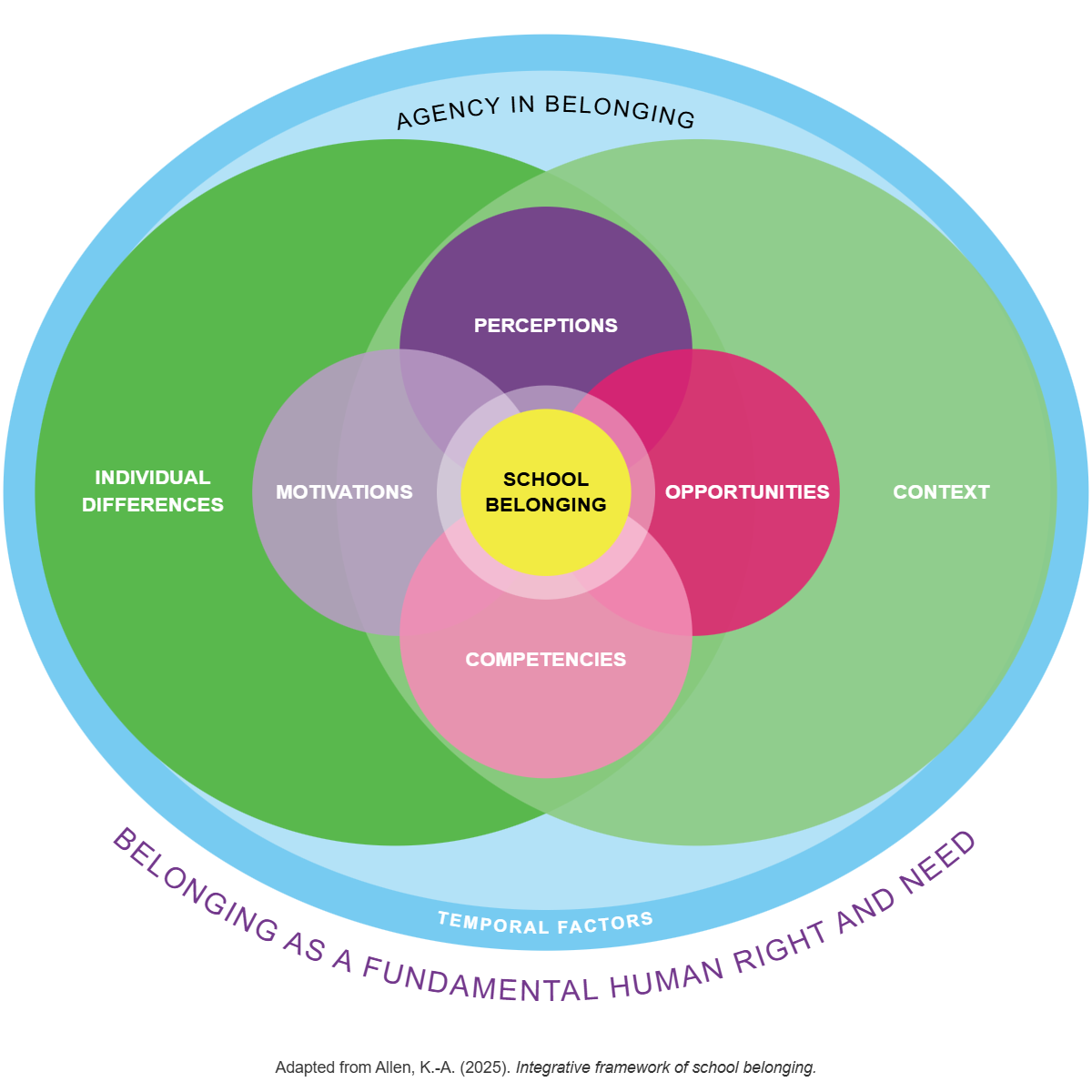
Allen frames belonging as a mostly active process, one that benefits from deliberate planning rather than being left to chance. That is good news for you as a school leader, because it means there is plenty you can do. The framework also calls for collaboration between staff, students and parents, so belonging becomes part of a whole-school approach to mental health and wellbeing. Schools that put it into practice can see better attendance, stronger student engagement and a more connected school community.
So where do you begin? We suggest starting with the relationships that shape a pupil's day-to-day experience of school, then building outward from there. Here are four areas to focus on, beginning with the one that matters most.
This has the strongest evidence base, and it is where we would encourage every school to start.
Non-teaching staff count too. Midday assistants, receptionists, ELSAs and librarians were all named by pupils as people who made them feel they belonged.
It is also worth remembering that staff cannot create belonging for pupils if they do not feel it themselves. Case-study schools consistently highlighted staff wellbeing, recognition and peer mentoring for new colleagues as a foundation for everything else.
Framework link: warm, consistent relationships shape pupils’ perceptions that they are known and valued, and create everyday opportunities to be noticed.
Pupils named friendship as the single biggest source of belonging. The evidence here is moderate but mixed, and Allen's work suggests the quality of peer relationships matters more than simply having them.
Promising approaches include buddy systems for new arrivals, cross-age mentoring, anti-bullying ambassadors, cooperative learning with purposeful pairings, and teaching friendship and conflict-repair skills. Protecting unstructured social time, such as a full lunch break, helps too.
Framework link: buddy systems and cooperative learning create opportunities to connect, while friendship and conflict-repair skills build competencies such as perspective taking and communication.
Belonging grows when pupils can genuinely influence the spaces they are part of. Give pupils real input into councils, policy, clubs and activities. Offer responsibility roles, and reach quieter pupils as well as confident ones.
Closing the loop matters. "You said, we did" updates show pupils that their views lead somewhere. Consultation that leads to no change can actually reduce belonging rather than build it.
Framework link: real influence creates opportunities to contribute and be valued, and seeing their ideas acted on strengthens pupils’ motivation to keep taking part.
Pupils are unlikely to feel they belong in places that feel unpredictable or unfair. Clear, consistent expectations, restorative conversations and well-planned re-entry after incidents all help. So does a firm stance on bullying and discrimination, and tracking sanctions and exclusions by pupil group.
This is especially relevant for pupils with SEND. The DfE data shows SEN pupils report significantly more bullying, and bullying overlaps heavily with a lack of belonging.
Framework link: Allen notes that motivation to belong wears down under repeated exclusion unless pupils can safely re-enter and try again. Restorative conversations and well-planned re-entry do exactly that.
Pupils need to see themselves reflected in school life. Audit your curriculum, displays, language and celebrations for whose identities are visible. Know pupils beyond labels of need. Wheeler (2026) warns against reducing young people to "the behaviour pupil" or "the SEN group", and argues schools should judge inclusion by whether pupils become recognised, participating members of the school community.
Framework link: belonging sits within wider social, cultural and structural forces, including power relations. Auditing whose identities are visible is one way a school can shift those forces, and pupils’ perceptions of whether they belong.
Emotional stability was among the stronger correlates of belonging in Allen et al. (2018). Regular check-ins, ELSA support, trauma-informed practice and calm spaces offered as a universal option all help. Where possible, support pupils within mainstream school life rather than through parallel provision.
Framework link: emotional regulation is one of the learnable competencies for belonging, and calm, universal spaces give pupils a safe opportunity to reset and re-join.
Primary-to-secondary transition and mid-year arrivals are high-risk moments for belonging. Multiple pre-start contacts, named adults and peers, and smaller identity units such as houses and tutor groups make a real difference. If you run targeted groups, avoid labelling pupils or grouping at-risk pupils together in ways that can reinforce difficulties.
Framework link: transitions are when belonging fluctuates most. Help pupils develop a belonging mindset: the understanding that it’s normal to feel unsure at first and that belonging grows over time.
The DfE data shows lower belonging among girls, pupils eligible for free school meals and pupils with SEN. White pupils reported lower belonging than Asian and Black pupils. However, the mainly US meta-analysis found girls slightly higher on belonging. That contrast is a useful reminder: let your own local data guide your targeting, not assumptions.
We want you to be able to trust what you read here, so it is important to be clear. Most of the evidence on belonging is correlational, not causal. Belonging and the factors linked to it probably influence each other in both directions. Many of the case-study accounts are self-reported, and some newer frameworks have not yet been tested.
That does not weaken the case for action. It simply shapes how we act. The research identifies plausible, repeatedly observed patterns, with adult relationships, peer connection, safety and fairness appearing most consistently. The sensible response is to choose a few well-evidenced belonging interventions, embed them into everyday practice, and evaluate their impact in your own setting.
Two areas of the evidence, peer connection and pupil voice, are where many schools find it hardest to know where to begin. Our Wellbeing Ambassadors programme is designed to bring them together in one practical, sustainable approach. In terms of the school belonging framework peer-led programmes work across all four elements at once: they create opportunities to connect and contribute, build competencies such as listening and empathy, strengthen motivation through meaningful roles, and shift perceptions, as younger pupils hear from older peers who have “been where I am”.
Wellbeing Ambassadors is a whole-school, pupil-led belonging intervention grounded in the SEARCH framework. Pupils are trained to run buddy systems, lunchtime drop-ins, transition support and anti-stigma campaigns. They also lead "you said, we did" feedback loops, giving you a ready-made record of pupil voice for governors and inspectors.
It uses a train-the-trainer model. Two members of staff complete the training, then lead the programme in-house with ongoing access to resources and support. No repeated external visits. Just lasting capacity within your own team.
Schools are already seeing the difference:
Peer support works best alongside strong adult relationships, not instead of them. Used together, they create the whole-school culture where belonging can grow.
Find out more: Download our free Peer Support Info Pack or watch our Introduction to Wellbeing Ambassadors webinar to see how peer-led initiatives could work in your school.
If teacher support is the strongest lever schools hold over belonging, then the skills staff bring to everyday conversations really matter. This is where coaching comes in.
Coaching gives staff a structured, practical way to have supportive conversations that help young people feel heard, set their own goals and grow in confidence. It builds the kind of autonomy-supportive relationship that the belonging research describes. And it fits naturally into the work you already do.
Some pupils need more than universal provision but do not meet the threshold for specialist services. Coaching offers a non-clinical, strengths-based belonging intervention for this middle tier of targeted support. Trained pastoral staff, teachers and support workers can use coaching skills in short, focused sessions with pupils showing early signs of disengagement, low confidence or attendance difficulties.
Coaching supports the antecedents of belonging directly. It builds competencies such as emotional regulation and communication, rebuilds motivation through goals the pupil chooses, and helps reframe perceptions, so that one difficult day isn’t read as proof that they don’t belong.
For pupils who need one-to-one support, Adolescent Wellbeing Coaching provides a consistent, trusted adult relationship. A UK grounded-theory study of coaching with young people at risk of mental health difficulties found gains in trust, accountability, self-awareness and a sense of control over thoughts and behaviour (Robson-Kelly and van Nieuwerburgh, 2016).
This approach is especially valuable during transitions. A pupil moving into secondary school, joining mid-year or returning after a period of absence often needs a named adult and continuity of relationship. A coaching relationship offers exactly that, helping the young person build the confidence and coping skills to find their place.
To be honest about it, the quantitative evidence for coaching with at-risk, secondary-age pupils is still developing and is mostly qualitative. That is why we build monitoring and evaluation into our training, so you can see the impact in your own setting.
Our Coach Training is an Accredited Award in Coach Training with the Association for Coaching and recognised as a Level 3 course with the ACCPH. It draws on more than 15 years of school-based practice and is designed specifically for working with young people, with attention to safeguarding, trauma-informed practice and developmental stages. Training is available in flexible formats to suit busy schedules.
Find out more:
As Allen’s framework shows, belonging is an active process: it is built through small, consistent signals that tell every young person they matter here, not left to chance. Greeting a pupil by name. Giving them a real voice. Making sure there is always someone who notices.
You may already be doing more of this than you realise. The task is to build on it with confidence.
If you are not sure which belonging intervention to prioritise first, our free Wellbeing and Inclusion Planning Tool can help. It takes under five minutes and gives you a personalised next step for developing belonging, wellbeing and inclusion in your school.
Take five minutes today and find your clearest starting point for building belonging.


LAST UPDATED:
November 11, 2026
Discover how fostering inclusion in schools through a focus on student wellbeing can enhance engagement and improve outcomes.
LAST UPDATED:
November 11, 2026
Belonging in schools starts with everyday practice. Research-backed steps to build belonging and wellbeing, through pupil voice and coaching


