✖

Last Updated:
October 1, 2026
DETAILED GUIDE for ScHools and Colleges
Written By:
Liz Robson
Strategic leadership of wellbeing involves the entire school community working together to implement processes and strategies that promote wellbeing for pupils, staff, and stakeholders. This requires active involvement from senior leaders, teachers, staff, parents, carers, and the wider community. When implemented effectively, personal development and wellbeing become central to the school’s culture and ethos.
One of the most powerful ways to support children in improving their wellbeing and preventing mental health challenges is through strategic leadership focused on belonging, inclusion, personal development and wellbeing. This approach creates an environment where both children and staff can thrive and succeed. It is sustainable and has a positive impact on key areas of school life, including behaviour, relationships, attendance, and academic achievement.

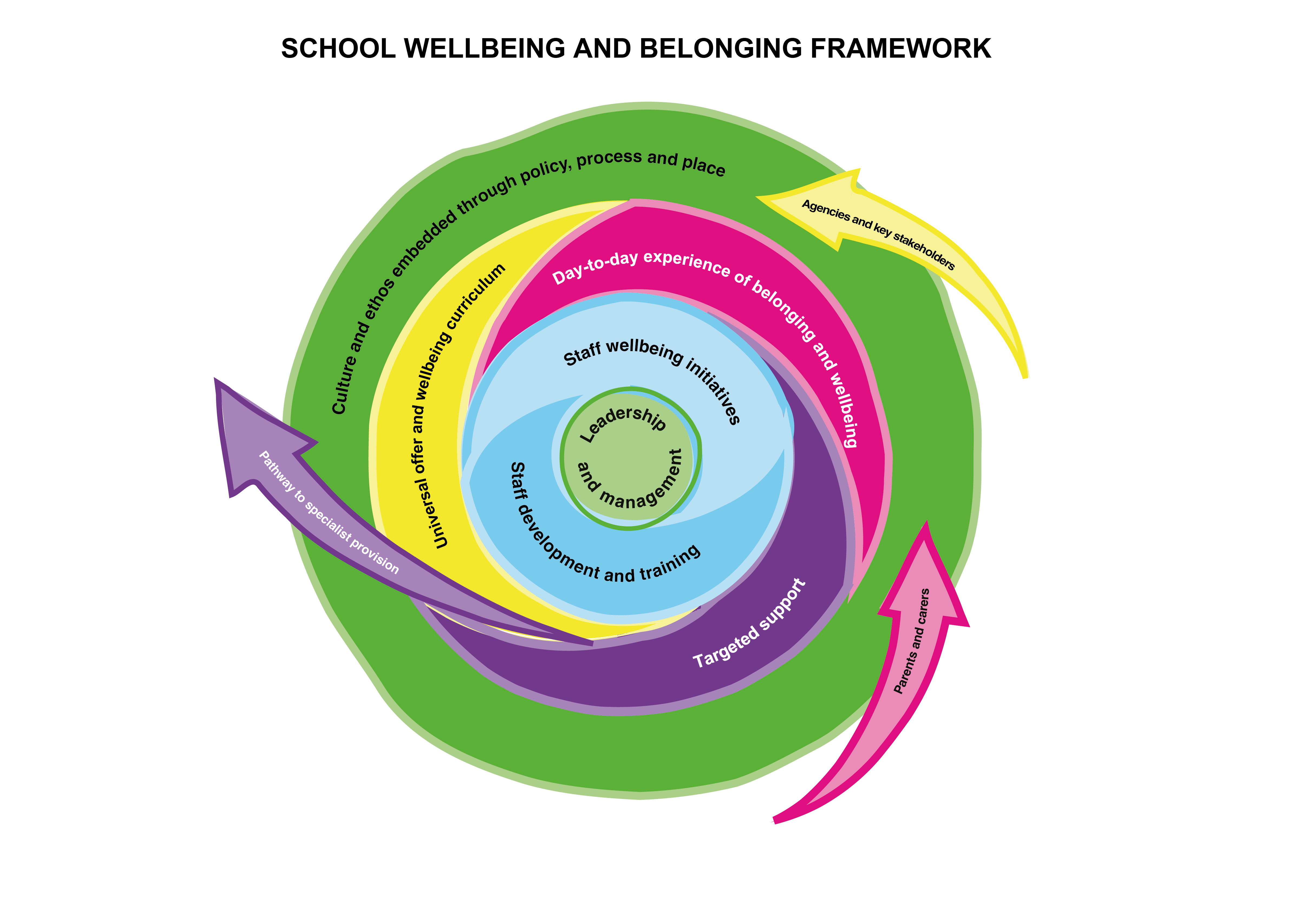
Our whole school approach to positive mental health and wellbeing, combines positive and organisational psychology theory with mental health in schools guidelines and recommendations. Our system model represents the dynamic way mental health and wellbeing is developed in schools and colleges. We use it to provide a framework for planning, developing and embedding school wellbeing.
The updated Ofsted Education Inspection Framework (EIF) places a strong emphasis on Inclusion, Personal Development and Wellbeing. Schools are now required to demonstrate how they promote pupils’ emotional, social, and moral development, alongside academic success. This includes fostering resilience, building character, and creating a culture of belonging.
The Wellbeing Club, our programme for School Leaders, provides schools with the tools, training, and resources needed to align with these new requirements. By leading a strategic approach, school leaders can ensure that wellbeing is not just an add-on but a core component of their ethos and daily practices.
Research shows that 1 in 6 children and young people in the UK have a diagnosable mental health problem. The Covid-19 pandemic then further amplified the need for schools to support mental health and wellbeing. This has been integrated into the latest updates of the Ofsted EIF and other guidance for schools that promote inclusion, personal development and wellbeing. In addition to this, there is a moral and educational imperative to act: improving wellbeing not only enhances learning and success but also protects the mental health of all children and young people.
The Department for Education (DfE) and Ofsted both recognise the critical role of schools in promoting mental health, personal development and wellbeing. The DfE encourages schools to appoint a Senior Mental Health Lead to support the development of whole school wellbeing. Ofsted, meanwhile, evaluates how schools integrate personal development, inclusion and wellbeing into their curriculum and culture, making it a key element of school improvement plans.
This is where we can help...
We piloted our approach to whole school personal development, wellbeing and resilience in 2016 by working with the NHS and 20 schools across Leicestershire. This provided key insights which led to the development of our leadership framework and approach to wellbeing this has now been delivered through our Wellbeing Club programme in over 110 schools nationally. This led us to create a simple way to help school leaders to develop and susiatain, inclusion, personal development and wellbeing.
Improving inclusion, personal development and wellbeing can feel like a big, overwhelming and potentially expensive task for headteachers and school leaders. That is why we created the School Wellbeing Framework: a simple way to share an effective, practical approach to inclusion and wellbeing with school leaders, staff, mental health leads and governors.
Using our framework will save you time, energy and stress, while bringing clarity and reassurance as you build a sustainable approach to personal development and wellbeing that fits the needs of your school, your pupils and your staff. It offers a step-by-step process, enabling you to audit, plan and take action in developing and embedding your school's approach to inclusion, personal development and wellbeing.
Worth-it's School Wellbeing Framework answers the question every leader is really asking: how do I lead this, and across which parts of school life? Its 10 areas are not wellbeing activities. They are the domains a leader has to own and sequence: Leadership and Management, Culture and Ethos, Staff Development, Staff Wellbeing, Curriculum, Day-to-Day Experience, Targeted Support, Specialist Pathways, Parents and Carers, and Agencies and Stakeholders.
This is the structure we have developed for the strategic leadership for wellbeing and inclusion. It is what a leader audits, prioritises and holds themselves accountable for, and what they draw on when evidencing to Ofsted and governors how they are leading their school to build sustainable, inclusive wellbeing for all.
There are 10 key areas where wellbeing can be promoted and built. This list provides an overview with some practical personal development and wellbeing activities you can use that lead a wellbeing strategy for all.
These 10 areas of a whole school framework help you reflect on the areas to lead and develop as part as your school's inclusion and wellbeing improvement plan, helping you put in place action steps.
Planning a wellbeing and inclusion strategy for your school doesn't need you to reinvent the wheel. but...it does require you to reflect on what you are already doing well and do more of those things, as well as take steps to address any gaps.
A simple leadership framework is useful to help you be able to work through this process of improvement and action planning without getting overwhelmed. Breaking your improvements and actions down by each area of the strategic approach makes that feel more straightforward, you can track your progress more easily and feel like you are moving your school forward.
Members of our wellbeing club are supported through ongoing leadership coaching and consultancy, school improvement plans and audit tools to develop their own that fit the need of their school community and help them feel clear that the plans they are developing are going to have a real impact on the mental health and wellbeing of everyone in the school.
Effective leadership of a school’s inclusion and wellbeing strategy requires a clear understanding of the complexities involved. Each element of inclusion and wellbeing within a school is interconnected, functioning as part of a larger system. Strategic leaders must identify how these elements interact and influence one another to create a cohesive approach.
This process is dynamic—changes in one area of wellbeing can have a ripple effect across the school. Over time, these changes can become self-sustaining if the core conditions that support and nurture wellbeing and inclusion are carefully cultivated and maintained.
Our strategic wellbeing framework is designed to help school leaders focus on specific aspects or take a broader whole-school approach to inclusion and wellbeing. There is no single starting point, as every school is already on its unique journey. We work closely with school leaders to enhance existing practices, strengthen key areas, and address gaps in their strategy and provision.
With our support, including wellbeing resources, CPD for school leaders, and tailored training for mental health leads, schools can adopt a strategic, impactful approach to inclusion and wellbeing that drives sustainable, positive change.

Our wellbeing and inclusion programme is designed to empower schools to thrive. By using the evidence-based Positive Education frameowrk the SEARCH pathways to wellbeing, developed by Waters and Loton after over a decade of research, we provide schools with a practical and proven approach to embedding wellbeing across their systems, processes and curriculum.
The SEARCH framework focuses on fostering character strengths, resilience, and emotional regulation, empowering students to manage challenges, build healthy relationships, and prepare for the future. Our Wellbeing Club leadership programme offers coaching, consultancy, training, tools, and resources to support school leaders, mental health leads in creating a positive and sustainable culture of wellbeing.
Through positive education strategies, we help schools implement activities that explicitly teach wellbeing skills, enabling students to develop emotional intelligence, cope with stress, and confidently navigate life's ups and downs. Together, we can build a foundation for student success and resilience that extends far beyond the school gates.
There are many benefits to leading and developing a strategic approach to wellbeing. The benefits don't only impact the pupils but create a positive ripple effect that impacts the whole school community and its stakeholders.

You may still be in the research phase about what the strategic approach to inclusion and wellbeing is. If this is the case, sometimes it can be beneficial to compare leading a strategic approach to the alternative. Some call the alternative 'reactive', but we think that 'piecemeal' captures the essence of a non-stratgic or tokenitsic school approach.
To assist you, we've developed a short comparison:
At Worth-it we have been working with 100’s of schools for 15 years, supporting them to develop strategies for positive mental health and wellbeing. We have combined our know-how and practical experience with the extensive evidence base underpinning our sustainable approach to personal devlopment and wellbieng. We didn't feel that some of the more popular wellbeing frameworks for schools explained the true nature of change require to promote wellbeing.
Therefore, we have developed our own dynamic ‘leadership system’ for developing and promoting wellbeing in schools covered above. We have chosen to refer to our school wellbeing framework for inclusion personal development and wellbeing as a system.
A systems approach considers the school as a complex and bounded unit. Within the school system, wellbeing can be led and developed as a whole through developing the interactions and interconnections between each element of the system. For example, improving staff wellbeing has a positive impact on pupil wellbeing. While developing pupil resilience, improves behaviour, which in turn reduces staff stress. This is a dynamic process that, once the necessary conditions have been put in place, becomes self-sustaining, highly efficient and low-cost to sustain over time.
Our aim is to support schools in leading and cultivating personal development and wellbeing at key points in their system. Our school wellbeing framework offers suggestions about where those key and unique starting points may be for a school. Providing a map or route to effectively plan a strategic approach to leading wellbeing. Our school system model can be used with schools, supporting them to reflect on the areas that already work well, identify any gaps in their provision, and plan a school personal development and wellbeing strategy.
We have developed our wellbeing leadership framework into a programme for school leaders and mental health leads. Our Wellbeing Club membership provides a year of access to training, support and resources that enable schools to promote an evidence-based wellbeing framework in their schools no matter what their starting point is or where they are on their journey to whole-school wellbeing.
We have developed a growing library of wellbeing activities, courses, CPD workshops and peer networking to provide school leaders and mental health leads with everything they need to promote personal development and wellbeing in their school or college.


